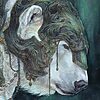
Exclusive interview with Lara Hochreiter, 1st Prize Winner, Catherine K. Gyllerstrom Emerging Artist Award in the 2025 Beautiful Bizarre Art Prize
Some works don’t announce themselves loudly, they simply unfold. They linger. They bloom in the quiet spaces where language fails. “He Grew What Couldn’t Be Spoken”, the winning artwork by Lara Hochreiter, feels like a patient, embodied process where something nurtured beneath the surface until it could no longer remain unseen. Awarded the 1st Prize of the Catherine K. Gyllerstrom Emerging Artist Award in the 2025 Beautiful Bizarre Art Prize, this painting, like her collective works, captures the sometimes-necessary balance that bridges vulnerability and resilience, giving form to what is often held inward, unnamed, or silenced. We have all know these moments.
Lara Hochreiter’s practice moves fluidly between the emotional and the material. Her work, like a deep root into the earth, transforms through interpretation and imagination like the quiet labor of becoming more than we already are. Often more than what we even realize we can be. Painting narratives that resonate to the human condition, each one invites reflection and recognition through symbolism. You chose the destination and intuitively feel that it’s not only created, but cultivated and shaped like a slow-burning, intimate dialogue.
Sink into this exclusive interview as Lara Hochreiter speaks about process, emergence, and the delicate places that inspire her vision. What we see is a portrait of an artist who understands that creation is an act of soulful listening – allowing what cannot yet be spoken to sow its spirit… and eventually, to grow.


Exclusive Interview with Lara Hochreiter
Your work seems grounded in realism and yet is beautifully infused with a surreal, ethereal presence. If the human form in your art represents a “vessel,” what is the lesson that this vessel is designed to hold in the context of contemporary society?
I perceive the human figure in my paintings as a vessel for our collective consciousness – a bridge between our roots, which I regard as pure and untouched nature, and the contemporary world, increasingly shaped by artificial constructs.
If you were forced to abandon all color on your palette, except for three, which would you keep and what essential part of your artistic voice (and psychological burden) would they be required to carry in future paintings?
I would definitely keep transparent red oxide, cobalt blue, and lead white. With just those three colors, I could still create a wide range of flesh tones and move from very dark to very light. I would miss having more intense, vibrant colors, but for me the most important thing is light and shadow. If the values work, the painting works — color becomes less important.
Similarly, your work uses intense colors and light as a language of emotion and introspection. Can you describe a specific “bridge” you cross while painting that perfectly captures a feeling that skillful technique alone cannot express?
That bridge could also describe my state of mind while I’m painting. I often try to bring myself into a similar emotional space as the figures in my work. Beyond technique, I think the real magic happens when you enter an almost meditative state, where painting feels guided more by intuition than by skill.


Thinking about the intentionality of your brushwork, can you remember a time when a “mistake” or “happy accident” forced your painting to take a sudden new direction that completely changed your original vision?
Yes, definitely. Especially at the beginning of a painting, I like to experiment and allow accidents to happen. I might mix a lot of turpentine into the paint, flip the canvas, let it drip, or even add sand to create texture. I don’t try to control everything, and that’s when interesting surfaces develop naturally. Sometimes I even mix what I think is the wrong color, but once I apply it, I realize it works better than what I had before — and the painting changes direction. I usually don’t make big compositional changes, though, because I test those ideas in small poster studies first.

Spray paint, oil pastels, gold leaf & oil on wood panel, 100 cm
“I perceive the human figure in my paintings as a vessel for our collective consciousness – a bridge between our roots, which I regard as pure and untouched nature, and the contemporary world, increasingly shaped by artificial constructs.”
Do you have a sensory cue that signals a painting is truly complete, or do you feel each piece could potentially stay in a state of constant evolution?
I know when a painting is done, sometimes it happens that I work a little bit too much on certain areas and I know that I could have stopped a little bit before to keep the freshness of some areas.


Would you share with us a little bit about your creative space, rituals, or habits that drown the (internal and external) noise of everything else when you’re creating a new body of work?
Research is a very important part of starting a new project. I try to stay observant and write down ideas as they come. That helps me develop the concept before I move too quickly into the visual stage. During that time, I also try to stay away from social media so I’m not influenced by other artists’ work. My mind can be quite busy, so I practice yoga in the mornings — it helps me slow down and think clearly. Once I’m in the creation phase, I don’t need much else. I often work for four hours straight in the afternoon, alone in my studio with just paint, canvas, and silence.
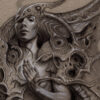
Looking specifically at your wining piece, “He grew what couldn’t be spoken” …as an artist whose work centers on themes of identity and the ongoing tension between our true selves and an “artificial world”, has this concept changed your own sense of identity over time?
I think being an artist means constantly questioning your own existence. This topic is very present in my life since I can remember. I feel sometimes almost nostalgic to a time when materialism – like we know it today – did not exist, where mankind was one with nature and could live a more truthful life.


And a few about the Beautiful Bizarre Art Prize…
Why did you enter the Beautiful Bizarre Magazine Art Prize?
I entered the fourth year of the Beautiful Bizarre Art Prize because I wanted to challenge myself. Especially at the beginning of your career, it can feel like you’re just painting for yourself. That can be beautiful, but also frustrating if not many people see your work. When I saw the finalists and winners, I felt inspired and wanted to reach that level. I also felt that the artist and gallery community around the prize was strong and professional.
What do you feel you have gained from this experience?
Since then, I’ve gained more confidence as an artist and had more time to think about where I want to go with my art. I’ve also made valuable new connections in the art world and have exposed in group shows.
Would you recommend it and encourage others to enter? If so, why?
I would definitely recommend participating in the Art Prize. It’s a great opportunity to create a strong, consistent piece and have it seen by international galleries and collectors.