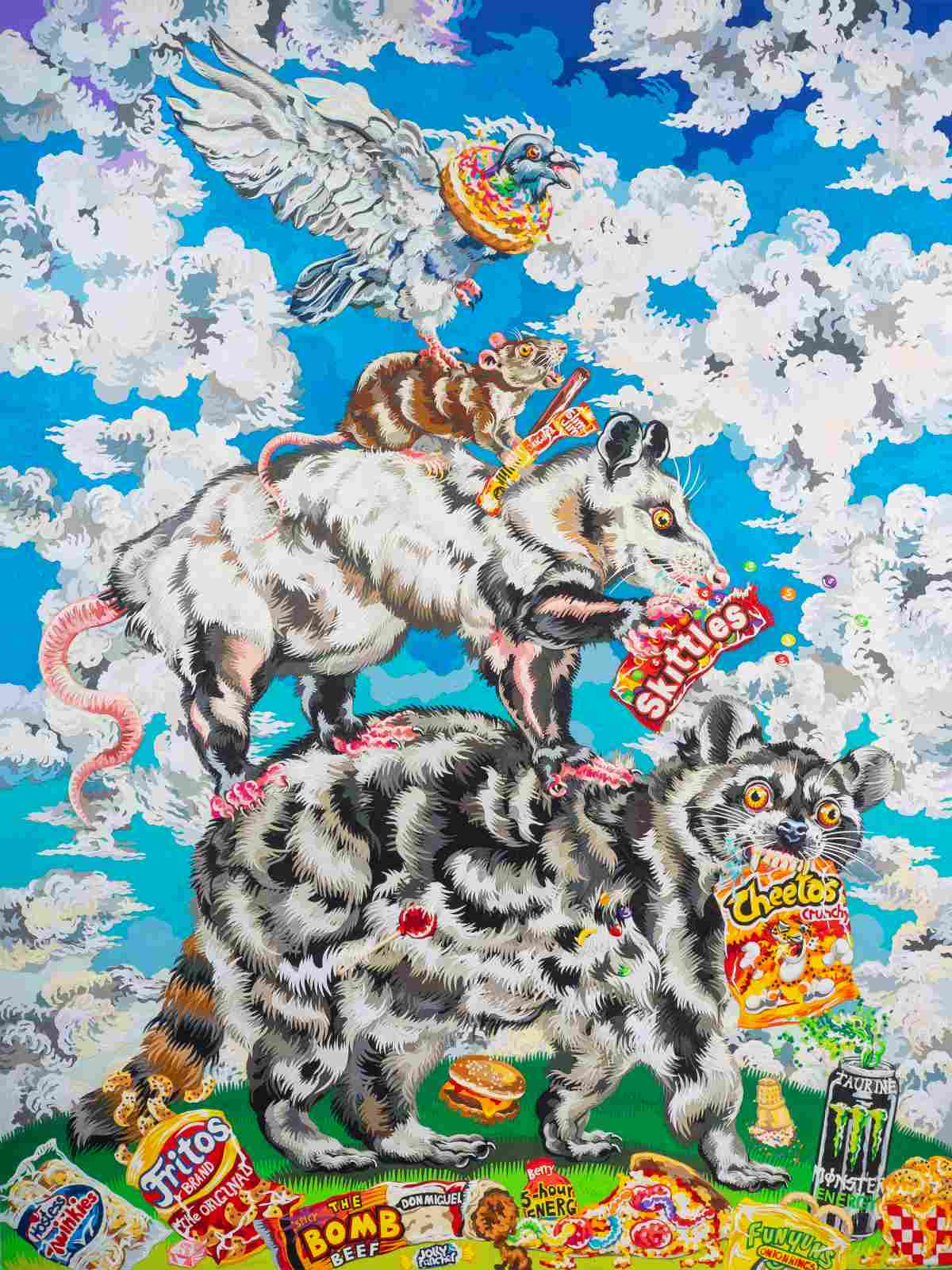
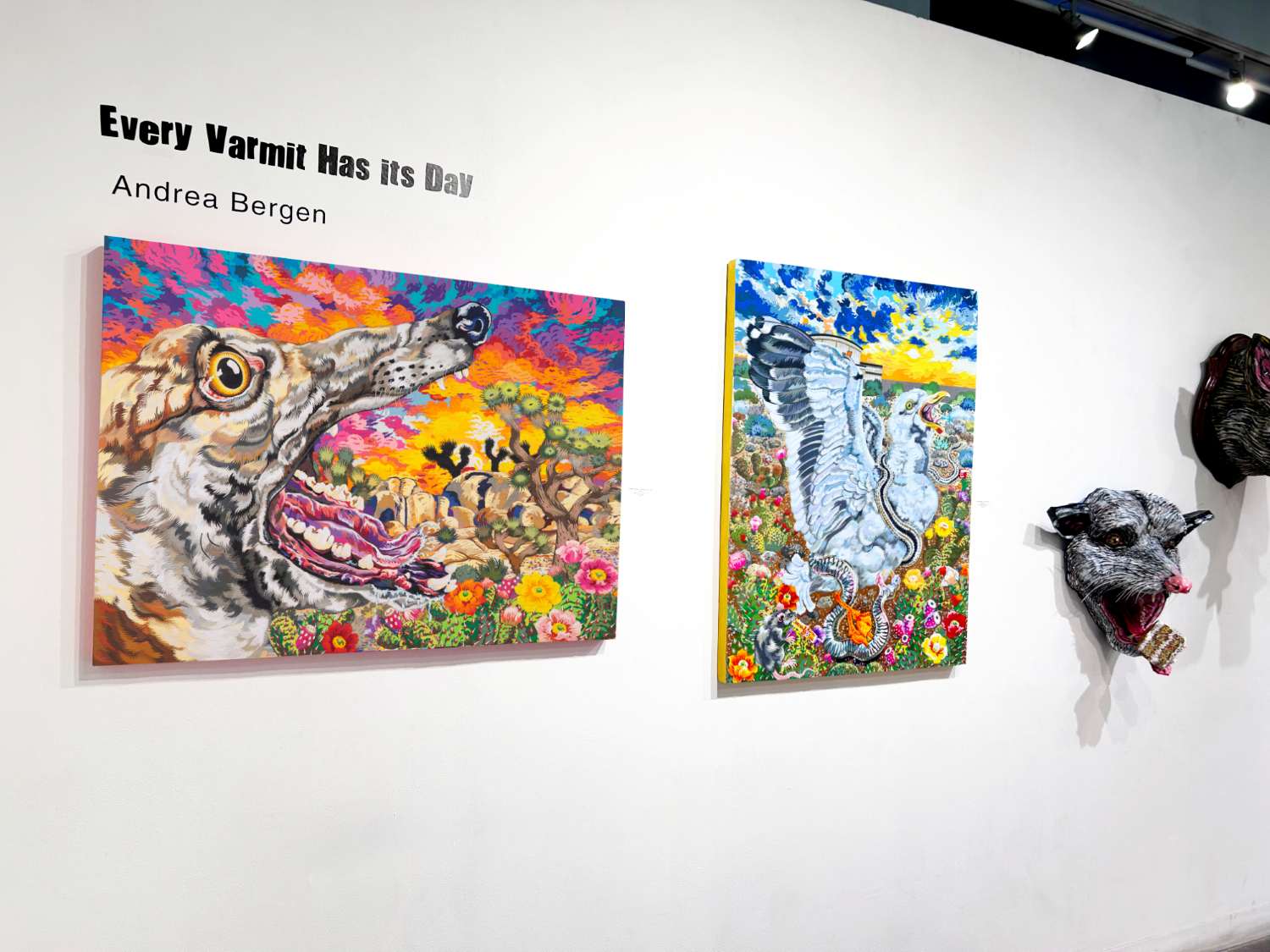
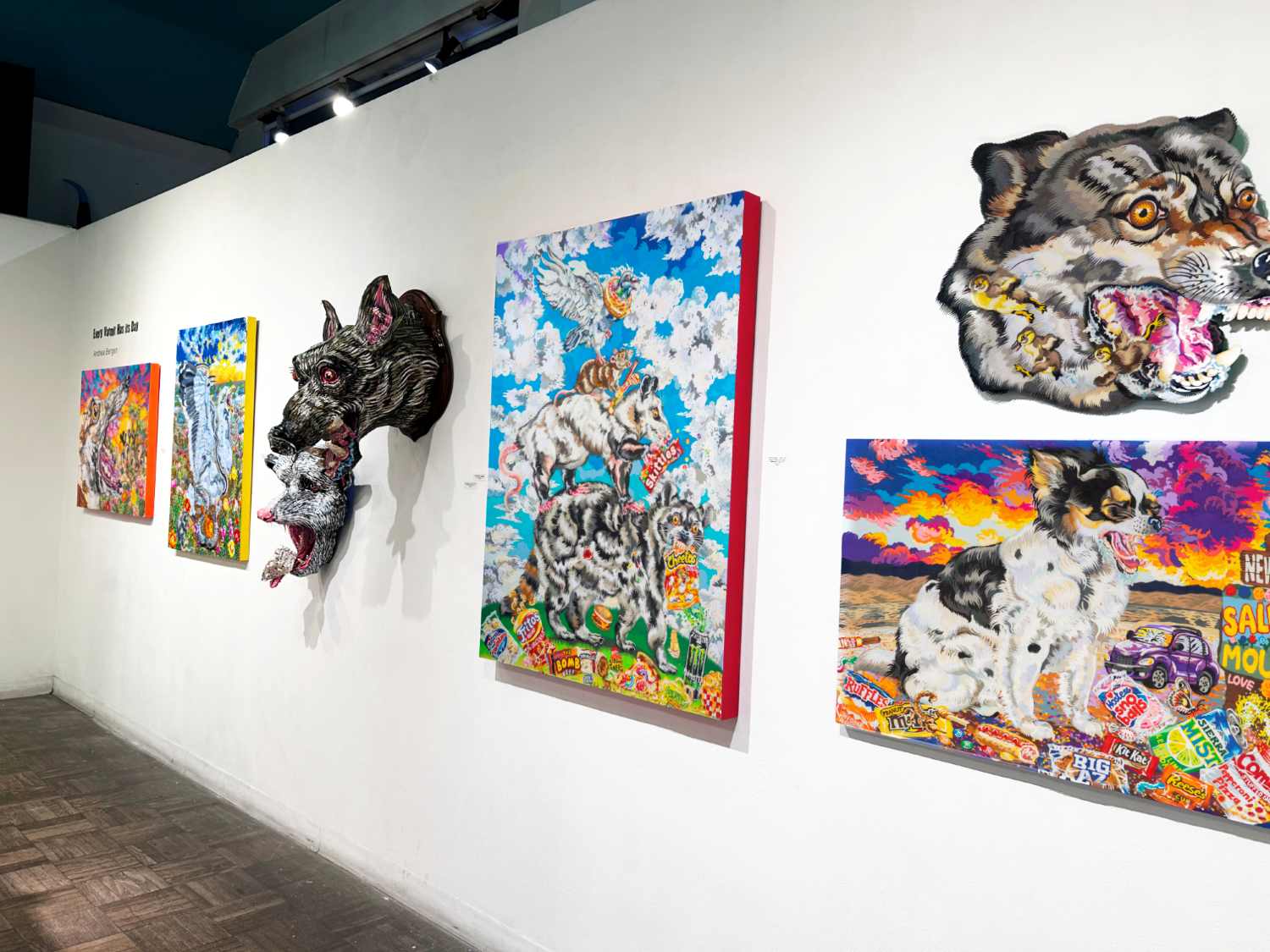
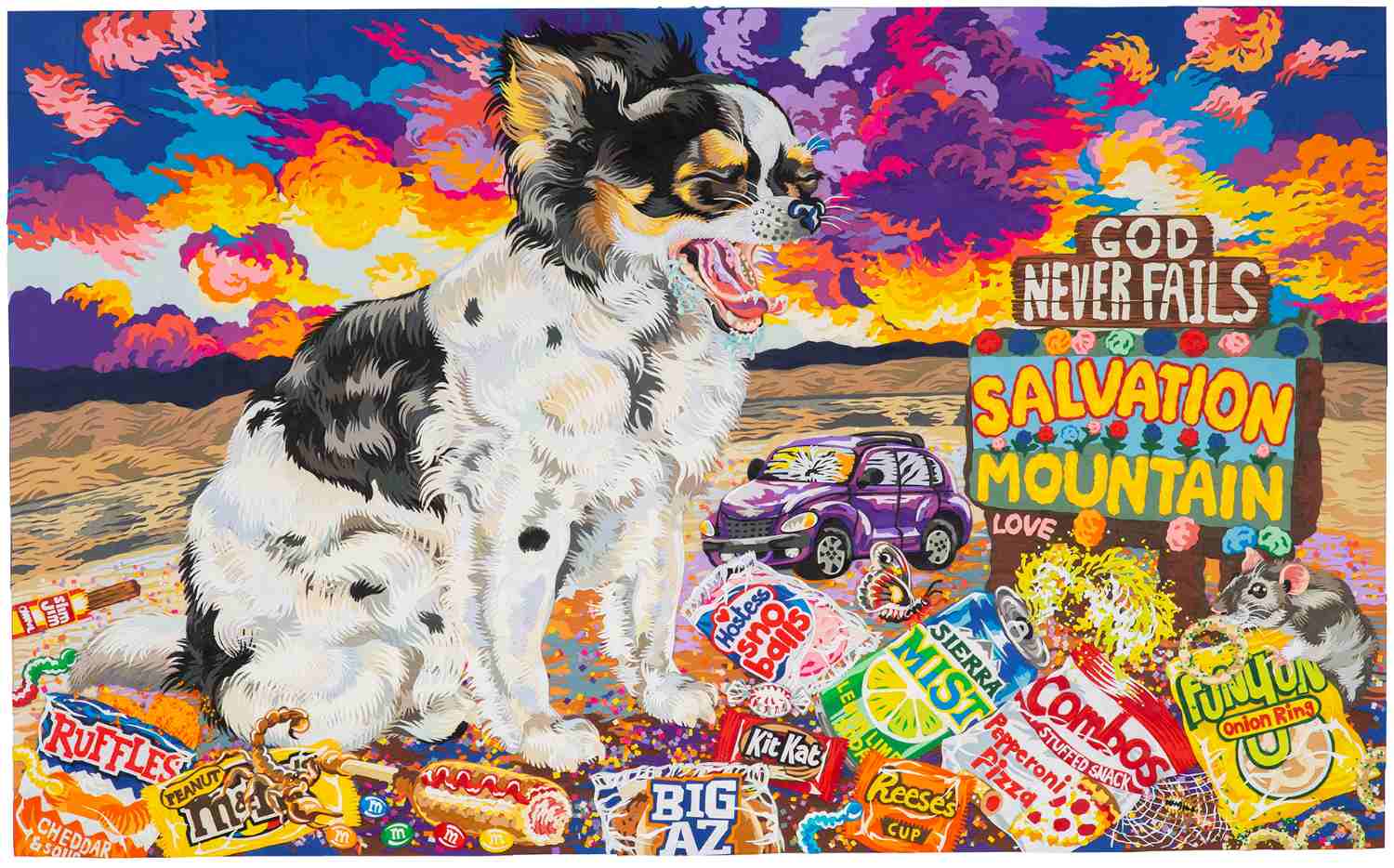
The end of the world is a truly horrific scenario for us humans. The flames of humanity extinguished, snuffed out as easily as a candle. This catastrophe will undoubtedly be at the hands of our own doing and while this may be all doom and gloom for us, it’s party time for the rest of the natural world. In Andrea Bergen’s ‘Every Varmit Has Its Day’, urban animals often labelled as vermin leap out from the shadows into the dusty pink glow of the morning sun ready to accept their new found freedom.
Those who once lived off scraps suddenly become kings as they fuel themselves with a colourful concoction of gas station goodies. Pizza flavoured potato chips combine with toxic green soda in an intoxicating gourmet feast. After dinner, they treat themselves to a haul of donuts, KitKats, and litter the floor with M&M’s (snacks for later) as they bask in the warmth of the sun and enjoy nature blooming on its own terms. Earth has now entered a new age. The utopian apocalypse begins here.
Born in Oakland, California, Andrea Bergen is an American artist best known for bold, humourous and politically charged mixed media artworks that depict apocalyptic landscapes and their cheeky inhabitants. Since graduating from the California College of the Art with a BFA in Painting and Drawing in 2013, Andrea has spent over a decade mastering her craftsmanship in collage art and sculpture.
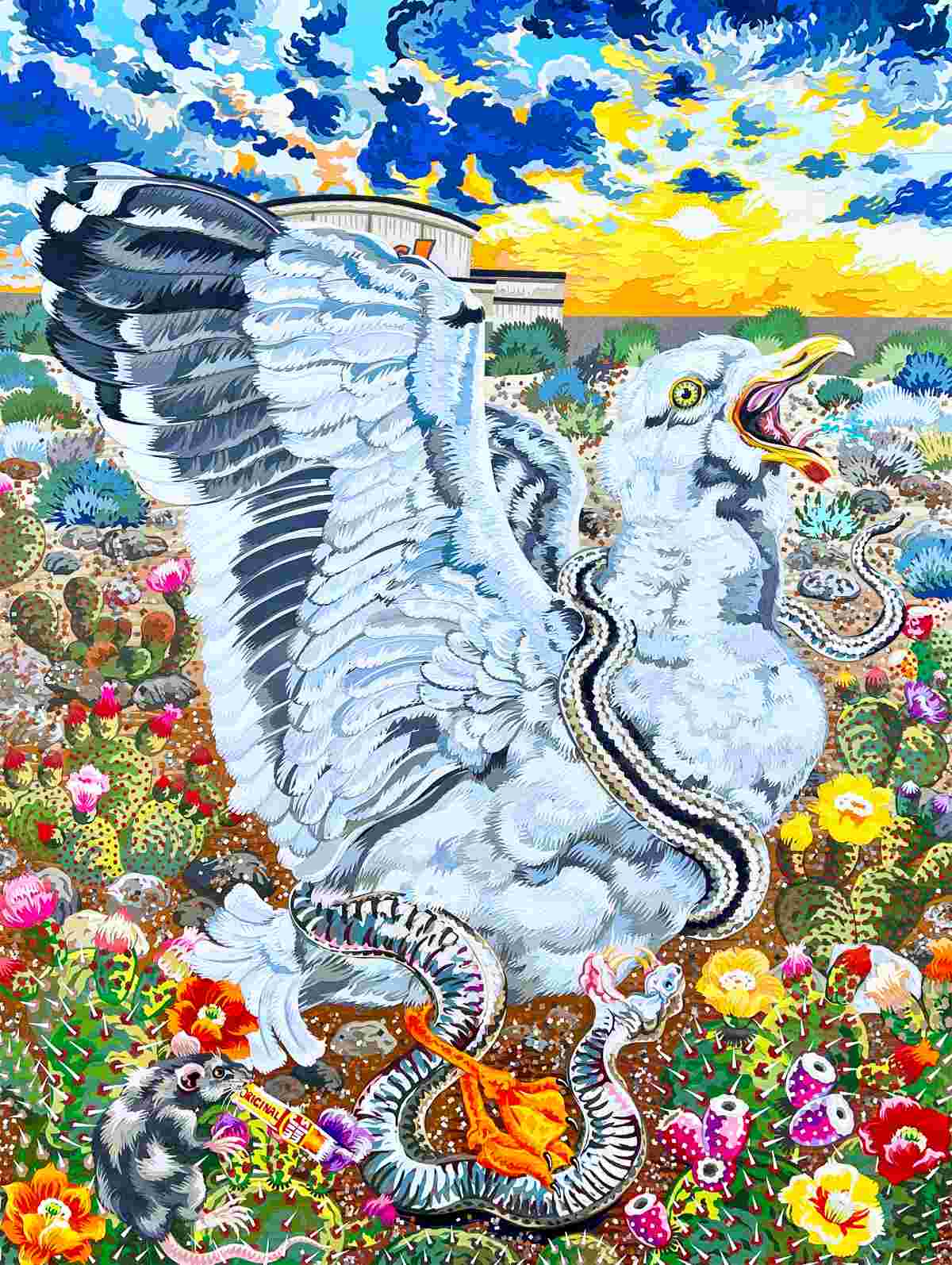
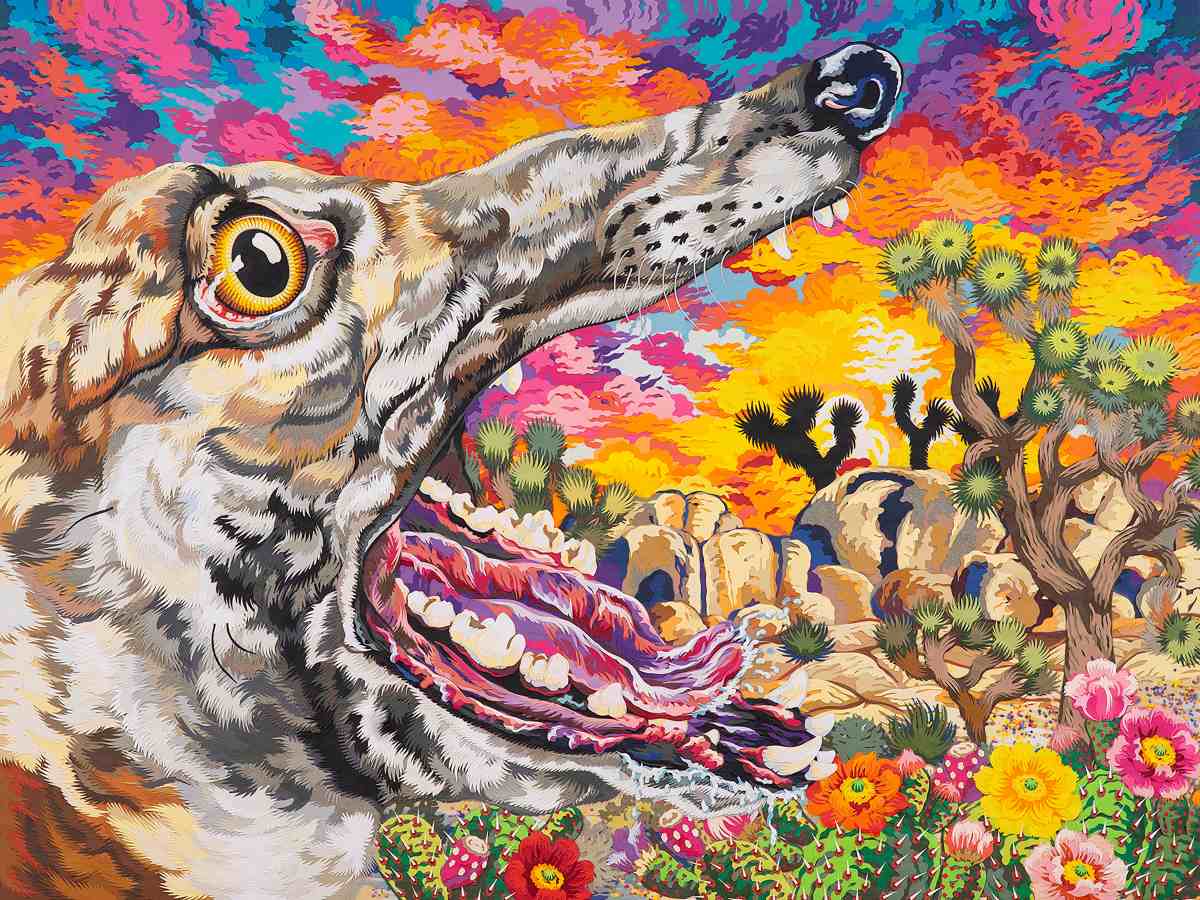
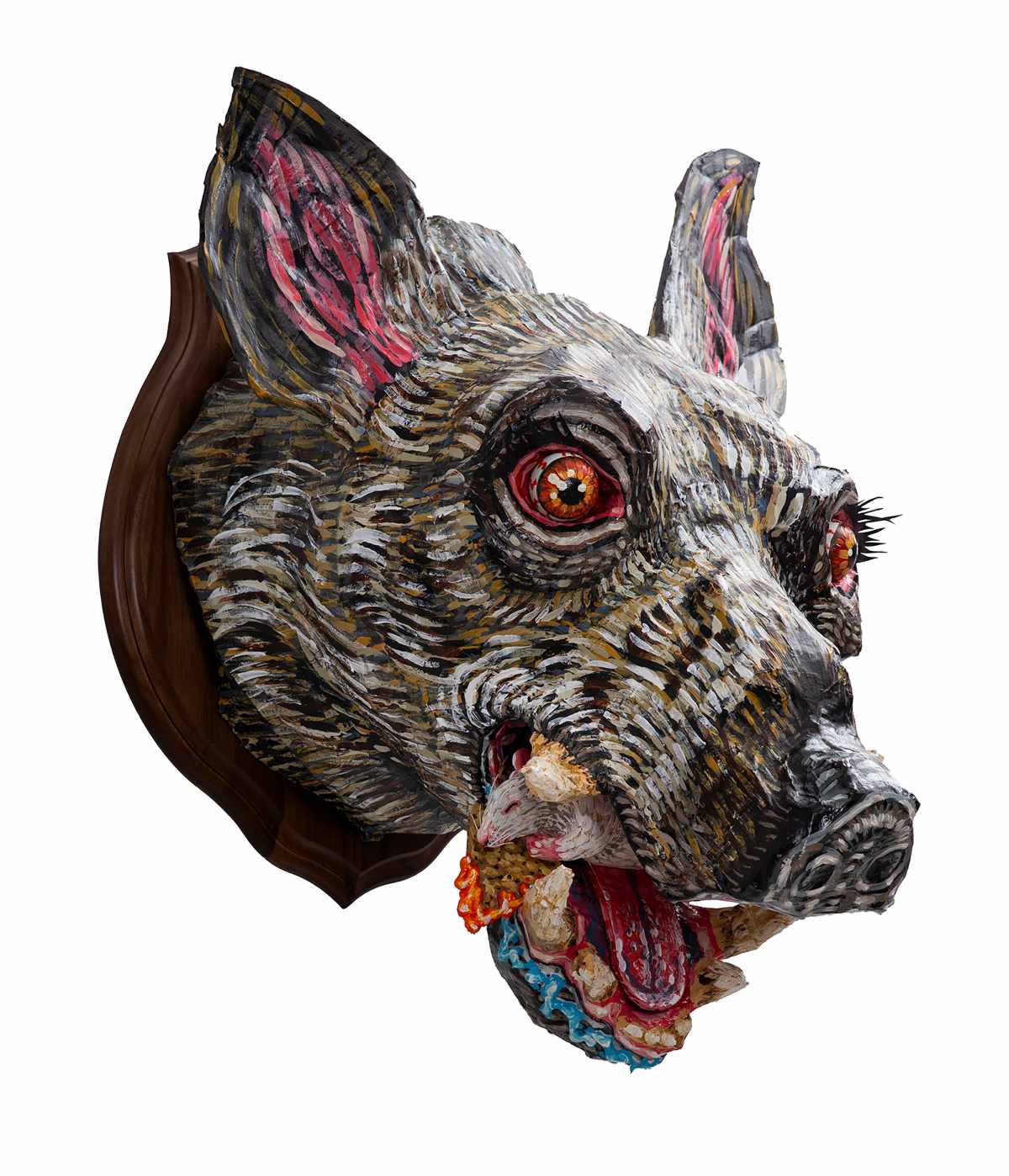
Her collage work simulates the look of oil or acrylic paintings but instead of paint, she paints with paper using thousands of meticulously hand-cut coloured papers layered together using her singular collaging technique. Andrea’s sculptures utilise papier-mache to create artworks that feel as though they’ve jumped out of her 2D works into our 3D world.
Andrea’s body of work acts as an emotional outlet for her anxieties about climate change, environmentalism and humanity’s continued role in these current issues. ‘Every Varmit Has Its Day’, her most recent mini solo exhibition held at La Luz de Jesus Gallery, continues this discussion through 9 unique sculptural and collage based artworks that depict a post-human utopian future where nature has begun to reset itself. Urban animals take on a new role in this ecosystem as Andrea depicts chaos, ecstasy, humour, and a true fondness for these often misunderstood creatures.
Artworks from ‘Every Varmit Has Its Day’ are currently for sale exclusively at La Luz de Jesus Gallery both in person at their Los Angeles location or online via their website.
Photo credit: Brandon Joseph Baker
Interview with Andrea Bergen
“Every Varmit Has Its Day” continues your artistic journey exploring your anxieties around climate change and environmentalism. Whilst these topics are heavier in nature, your work has a playfulness in terms of colour schemes and composition that makes the message impactful yet upbeat. Can you tell me a bit about your relationship with environmentalism and how you chose to explore this theme in your latest show?
I have loved animals and nature for my entire life. I grew up in the Bay Area near a regional park where I could explore the forest. My family frequented the Lindsay Wildlife Museum, an educational and rehab center for birds of prey where families could rent guinea pigs and rabbits for the weekend. My brother and I would ride ponies and feed cows and sheep at The Little Farm in Berkeley.
My favorite books were richly illustrated animal-centric stories by Graeme Base and Beatrix Potter. My school folders and notebooks were covered with rainbow leopards and dolphins from the fantastic and colourful world of Lisa Frank. After doing projects on whales in 5th grade I was briefly very interested in becoming a marine biologist.
When I first began collaging over a decade ago, abandoned roads and places along Route 66 were my main references. As the landscapes developed and animals entered the scenes, the environmental thread developed. I began to think of the collages as visions of the future in a post-human world. The collages are an outlet for my anxiety regarding climate change in which I can enact my wishes for the wellbeing of the animals. Rather than showing the devastation and destruction of humanity, the landscapes show the resilience of nature. In this alternate reality the wildlife adapt and thrive within the changed environment.
Given that your work focuses on themes of environmentalism, what are some of the things you do, and could encourage others to do, to help our planet out whilst still being creative?
I do my best to conserve resources in personal life and remain mindful about my consumption. I stopped eating meat and try to choose the lesser evil in the companies I support but I fall short all the time. In my art practice I try to find ways to utilise recycled materials but I buy new paper and polymer mediums and paint. This hypocrisy of participating in environmental destruction while making work about nature is something that I work out in the pieces as well, the guilt of being a consumer in a capitalist system is maddening. It’s become almost impossible not to set off a chain of suffering with any purchase.
This madness expressed through wall-eyed, drooling expressions of the animals. Single use consumption and waste is the path of least resistance, it takes a lot of energy and privilege to fight against it. Individual actions can create incremental change but the cards are stacked against us when the system is designed to churn and burn resources with only the present in mind.
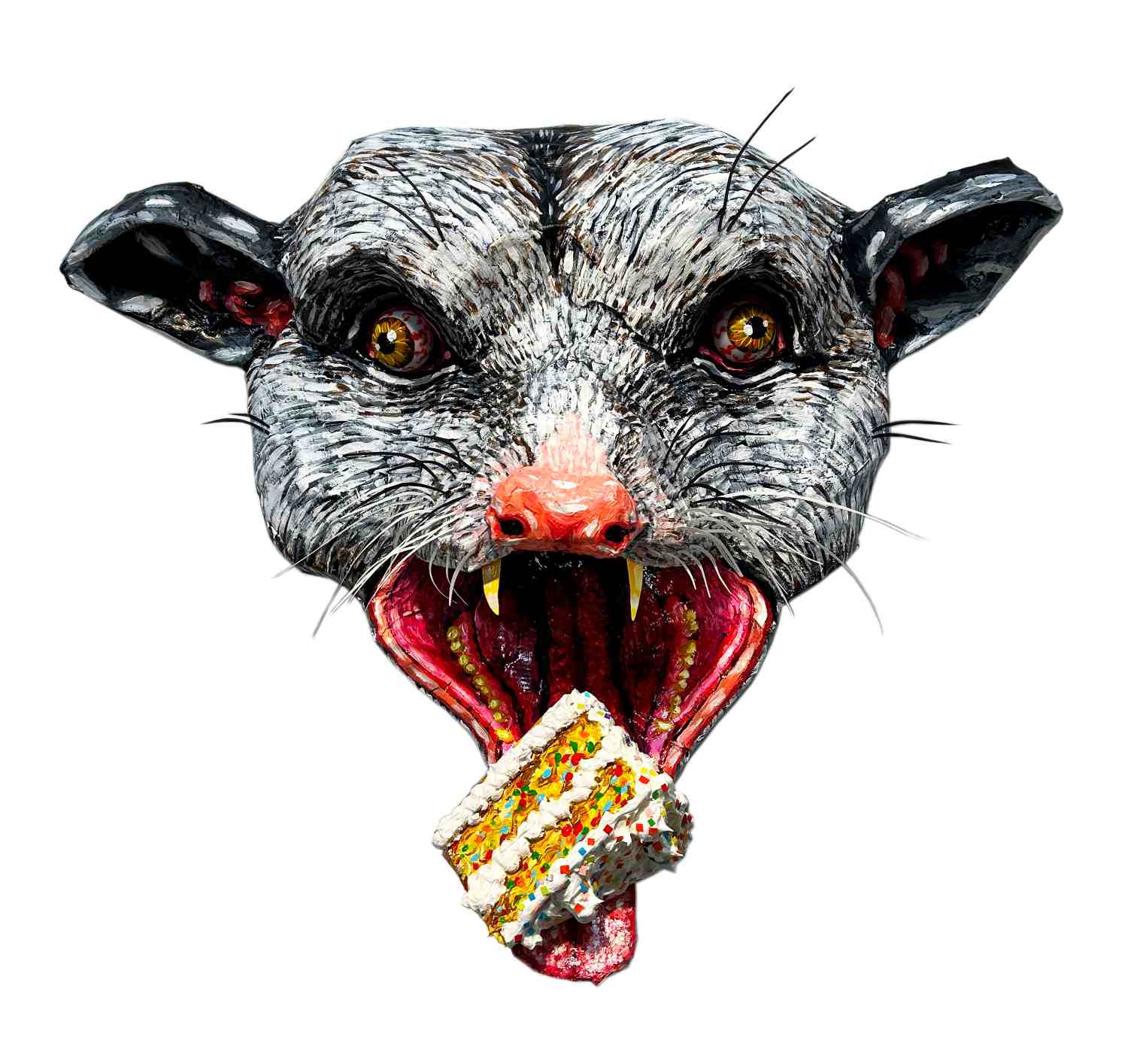
Animals play a key role within your work and this show in particular feels like a real celebration of the animals classed as “vermin” by many. What are your own thoughts and feeling towards these creatures? Do you have a soft spot for them?
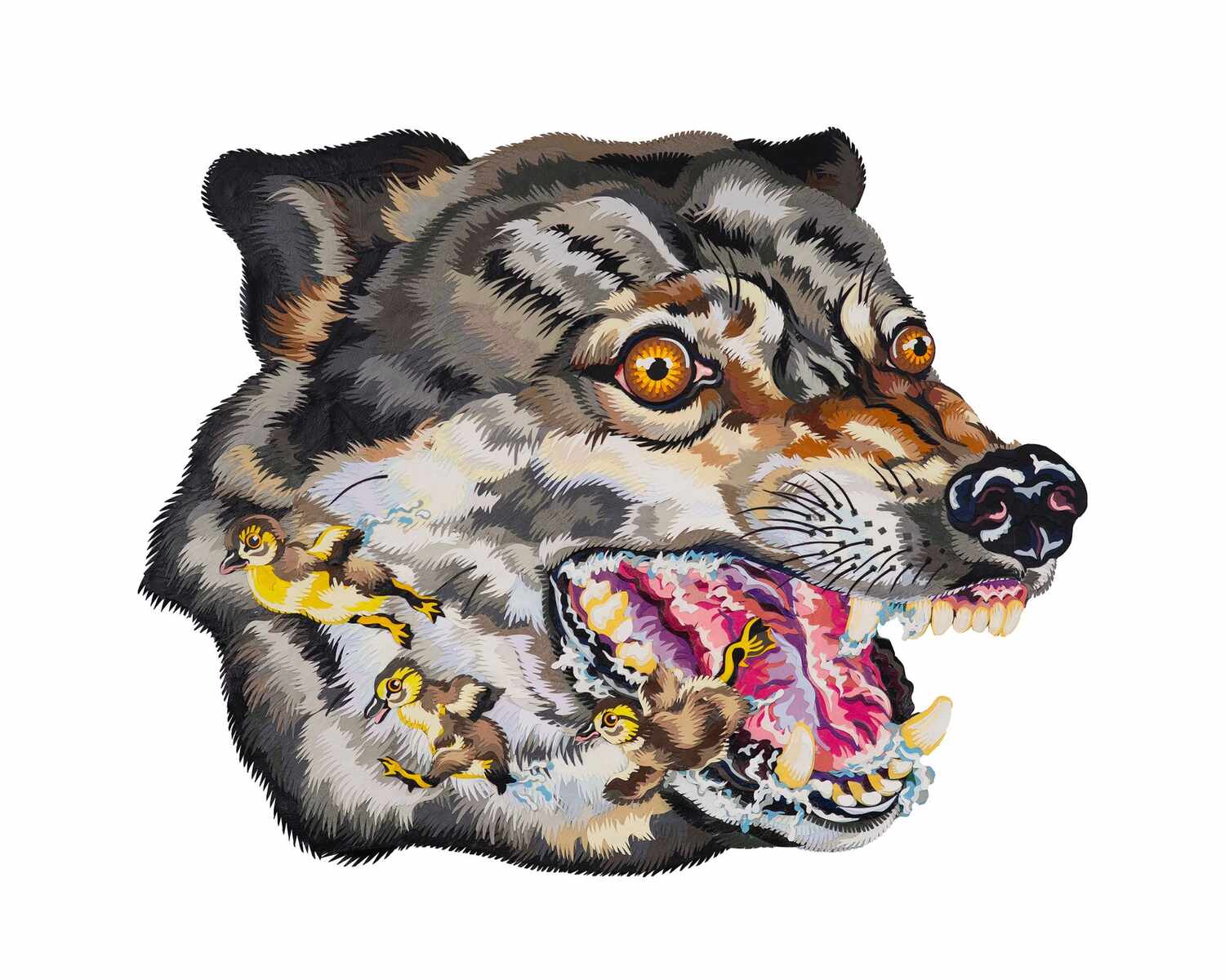
My work focuses on urban animals like raccoons, rats, and pigeons because they are most closely habitating with people and have had their environments drastically changed by urbanisation. They have benefited from this development with easier access to food and shelter but also face constant human threat of violence. For example pigeons get diabetes from the human food they eat off the street and that’s why they are often missing toes or feet.
I definitely feel a soft spot for these creatures and detest the cruelty which with they are often treated. Because we can’t realistically live with them, even I don’t want mice and rats in my house, the collages are a way to honour their short existences and remind the viewer of their beauty and unique qualities. The pieces are my sanctuaries for them. This is also why they are idealised and in perfect form in my work. I don’t want to create any more pain for them, only an endless buffet. That’s what the title of the show referred to, these “vermin” and “varmints” inherit the earth and finally get their time in the sun.
How did you find the process of working on “Every Varmit Has Its Day” and were there any moments you found to be particularly rewarding?
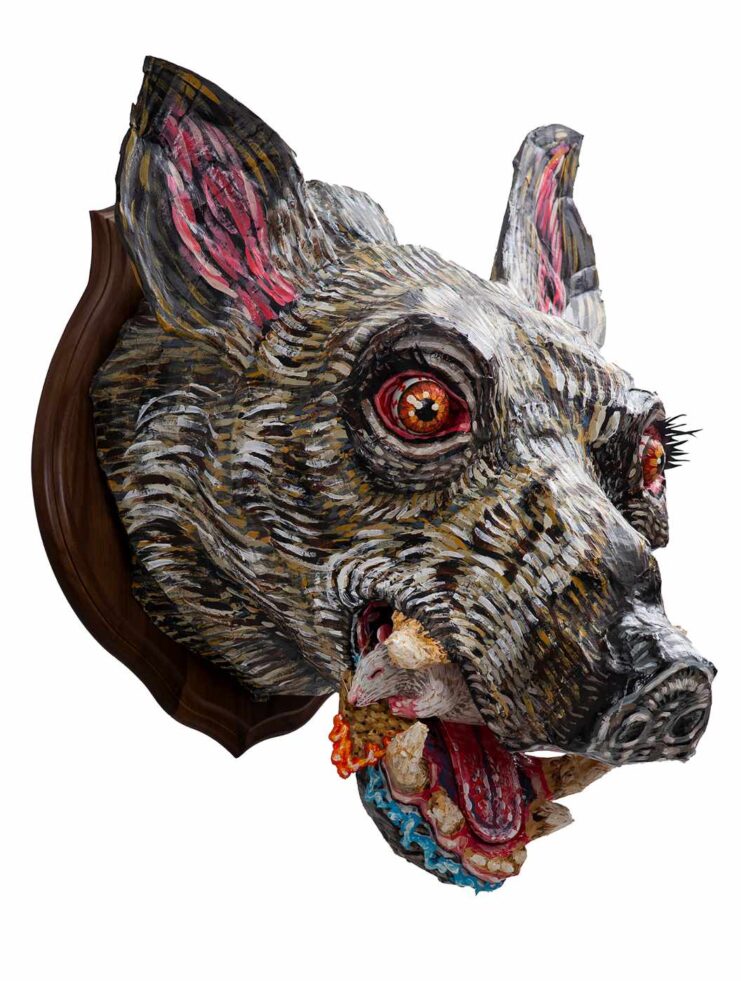
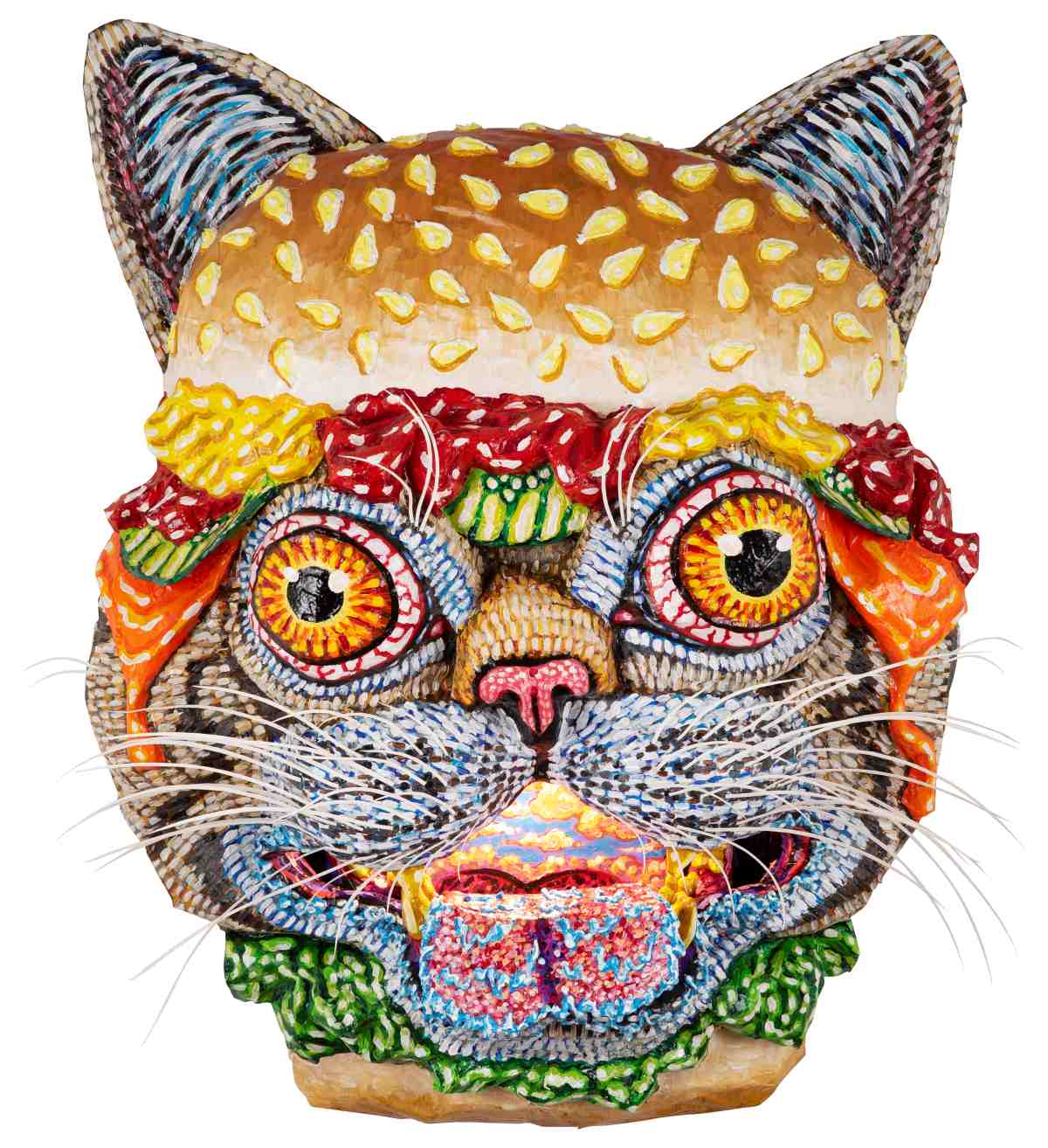
I have been working with Papier-mâche sculpture for about 8 years and wanted to push the medium further for this show. I had a little advancement when I was creating the large hamburger cat head wall sculpture “When It Tastes Heavenly.” This is the first sculpture I’ve made that incorporates light. I installed a light in the roof of its mouth to illuminate the painted sky inside. This was a small but rewarding development for me as I strive to make my pieces more and more immersive.

The artist created installations Meow Wolf are a big inspiration for me. I love the idea of creating a totally immersive environment that puts the viewer inside the world of the work. One day I would love to completely take over a space with my work to bring the audience fully into the story.
What did you find to be the most challenging aspect of working on ‘Every Varmit Has Its Day’ and how did you overcome these obstacles?
I have a painting background and have the most experience working in 2D mediums. Before I began focusing on the collages in 2013 I was making large scale acrylic and oil paintings. As I move towards the installation and spatial work my mental engineering muscle needs to develop. In addition to the aesthetics of the piece, the sculptural work requires structural consideration.
There has been quite a bit of trial and error when it comes to the building of the sculptures. The internal building can feel like eating vegetables when I want to get to the dessert of painting all the colourful details on the exterior. Previously in my haste to get to the fun I have had pieces cave in on themselves because I rushed through the building process. This time I carefully considered how I was putting the sculptures together so that they would maintain their integrity.
What do you hope viewers can take away with them after viewing the works included in this exhibition? Do you hope viewers will strive to become more environmentally conscientious?
My work is my mental refuge from the realities of climate change and bad news. The fantasy brings me joy and some refuge. They are my offerings to peace in the universe. I am extremely fortunate that I have the time and space to create this work. Ultimately I want to fun viewing experience of my work.
The most satisfying comment to hear at a show is that the pieces made someone happy. If after seeing my work the audience takes even a moment to appreciate the beauty and whimsy of the everyday world I would consider that a great success. Treating animals with kindness is a reflection of a healthy society. Even just scooping a worm from the rainy sidewalk onto the grass effects change.