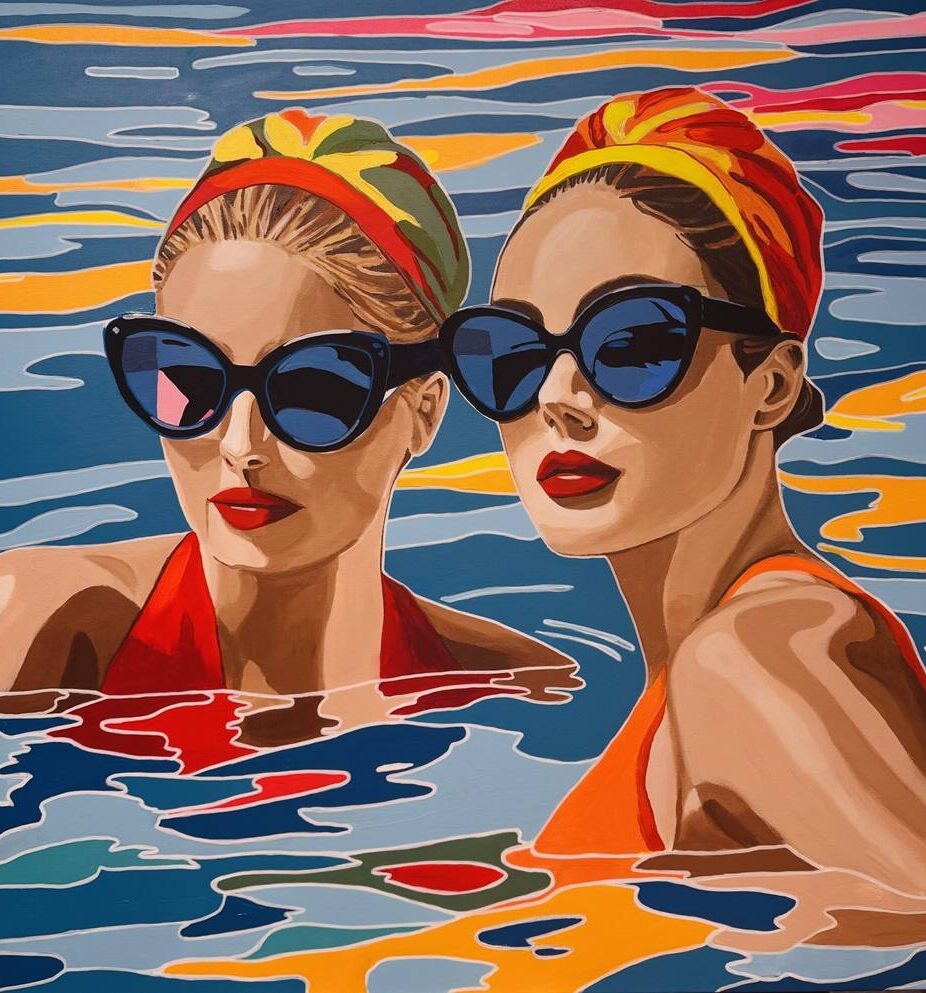
There are times when you see something and it triggers a memory, a powerful sensation. It rushes through you like a wave to the shore, moving your waters and calling you back to a place that needs revisiting. Kasisa Davies‘ paintings do just that; they speak to you. Each subject shares an intimate story we long to know more about, yet leaves behind a trace of mystery that only adds to the fascination. Her work serves as a bridge between the past and the future, blending classical techniques with modern sensibilities to create art that is both exquisite and thought-provoking.
Kasia Davies’ fusion of Pop Art and Impressionism lends itself to an undeniable vintage charm. The luminous light and soft atmosphere of her figures embody the divine feminine archetype, inviting a deep sense of tranquility. The presence of each subject is explorative, and though the mastery of color speaks to contemporary themes of beauty, there is something far deeper to contemplate.
The emotional resonance of yesteryear, alongside a natural grace and elegance, seems to preserve the spirit of her portraiture. Dive into the deep end of her work and learn more about her background, creative process, visionary aesthetic, and much more!
Color and light are my emotional language; they help me express mood more than detail. My work tries to hold space for both joy and depth — something playful on the surface, but with emotion underneath.

Exclusive Interview with Kasia Davies
Admiring your work feels like time traveling; each piece is a portal to moments captured in vibrant colors, playful ambient mood, and a celebration of feminine resilience that speaks profoundly. What do you consider the core elements of your artistic vision?
Thank you, that really means a lot. At the heart of my work is a love for capturing quiet, everyday moments — especially those that feel a bit dreamlike or nostalgic. I’m drawn to women in calm, reflective states, surrounded by warmth, water, and light — those in-between moments that are soft but full of presence.
Color and light are my emotional language; they help me express mood more than detail. My work tries to hold space for both joy and depth — something playful on the surface, but with emotion underneath. It’s about connection, memory, and celebrating the quiet strength found in softness.
For me, art isn’t separate from life; it’s how I move through, understand, shape, and challenge the world. My journey keeps evolving, but one thing is clear: art isn’t just something you make — it’s a way of being, a way to turn experience into expression.

Many have a story of how their art journey began — whether a childhood moment, a transformative experience, or influential people — your journey is unique. Will you share yours and the milestones or challenges that have marked your path?
My artistic journey has never been a straight line. It’s been a blend of creativity, curiosity, and entrepreneurship. I never felt limited to one role or medium. From the start, I was drawn to all forms of expression — theatre, music, design — and I’ve followed them with equal passion.
I studied theatre, management at the London School of Management, and completed an interior design course in Warsaw. It’s the blend of these fields — and the spaces between them — that shaped who I am. Over the years, I’ve worn many hats: artistic director, music producer, scenographer, founder of a recording studio and music label, and even band manager.
What ties it all together is my drive to create experiences — whether visual, spatial, or musical — that resonate. For me, art isn’t separate from life; it’s how I move through, understand, shape, and challenge the world. My journey keeps evolving, but one thing is clear: art isn’t just something you make — it’s a way of being, a way to turn experience into expression.
There’s a bittersweet nostalgia I want to hold onto — not for the past itself, but for how it felt to be more connected with ourselves and others. My portraits capture people in solitude or quiet companionship, without performance — just being.

Beyond the timeless vintage aesthetic of your work, what emotional feeling of this bygone era are you trying to preserve in your portraits?
I’m really after preserving a sense of calm intimacy — those quiet, almost cinematic moments when time seems to slow, and everything feels present and real. The vintage style isn’t just fashion; it’s a way to evoke an emotional atmosphere, a tactile memory. I’m drawn to softness, warmth, and light — not just visually but as emotional textures that speak of simplicity and reflection.
There’s a bittersweet nostalgia I want to hold onto — not for the past itself, but for how it felt to be more connected with ourselves and others. My portraits capture people in solitude or quiet companionship, without performance — just being. That stillness, that authenticity, is what I want to keep alive. It’s not nostalgia for nostalgia’s sake but a way to remind us of how powerful those subtle human moments really are.
You graduated from theatre studies at the London School of Management and the Interior Design Creator course at the Academy of Fine Arts in Warsaw — how do you integrate these into your current work?
My background in theatre and interior design deeply shapes how I create — visually, emotionally, and conceptually. Theatre taught me to build atmosphere and understand story through space, light, character, and silence. That narrative sense carries into my paintings — each a moment caught mid-scene, between gesture and stillness.
Interior design showed me how people move through space and how surroundings affect feelings. When I paint, I’m composing more than a figure — I’m composing an emotional space. I think about how my work will live in the world — not just on a wall but within light, texture, and energy.
When I work, I’m not just making an image — I’m imagining how it will exist in someone’s world. This blend of visual and spatial thinking helps me create paintings that feel grounded, connected, and part of something bigger.

Similarly, how does the space between interior design and traditional painting influence the composition and harmony of your work?
The connection between interior design and painting shapes my approach a lot. Interior design taught me to think about how art lives in a space — how it interacts with light, walls, and the energy of a room. That awareness influences my compositions.
I consider balance and harmony like when designing a room. I pay attention to how colors sit next to each other, how shapes carry weight, and how empty space — like silence in conversation — adds meaning. I also think about the feeling the work will create in its new home — calm, tension, warmth, or curiosity.
So when I work, I’m not just making an image — I’m imagining how it will exist in someone’s world. This blend of visual and spatial thinking helps me create paintings that feel grounded, connected, and part of something bigger.

Would you briefly walk us through your creative process and what a typical day looks like?
I usually wake up early — I love the calm and clarity of mornings. Most of my day is spent creating — painting, sketching, and developing ideas. But I also wear many hats: I’m my own manager, creative director, marketing and social media manager, booking assistant, shipping coordinator, and sometimes even the driver for deliveries or material pick-ups.

My process is intuitive. I often start with a feeling or image, then build the composition around that. Color is key — I experiment until it feels emotionally right. I work in layers, both on the canvas and emotionally, often stepping away to come back fresh.
It’s a busy, varied rhythm — switching between roles and creative work — but I wouldn’t have it any other way. That mix is what keeps my work alive and meaningful.
Playing with color lets me express feelings that words often can’t.

What aspects of your artwork do you find the most enjoyable to work with? What makes these elements fulfilling?
Color and light are what I enjoy most. They have this amazing power to shape mood and emotion, creating atmosphere. Playing with color lets me express feelings that words often can’t.
I also love capturing quiet, intimate moments — small gestures or expressions that tell a story without words. Creating a space where people can pause, reflect, and connect emotionally feels deeply rewarding.
Outside the studio, I get a lot of energy from talking about my art, attending shows, preparing exhibitions, travelling, and selling my work. Seeing how my art connects with others inspires me to keep going. All these experiences fuel my creativity and make the process even richer.

Many of your subjects appear tranquil, playful, and introspective — each seems to embody the divine feminine archetype. When viewers look at your subjects, what do you want them to experience?
When I paint these figures — calm, playful, or quietly introspective — I want viewers to feel like they’re stepping into a private, authentic moment. These subjects embody the divine feminine as real, living energy — strength in softness, power in stillness, beauty in presence.
I hope people see a bit of themselves or someone they know in these moments. It’s about connection and feeling those simple, honest emotions. I want my paintings to remind viewers how beautiful and powerful quiet, everyday feelings really are.

2025 is quickly coming to a close — what are you working on, and what’s on the horizon for 2026?
2025 was a busy and exciting year. I took part in many exhibitions across Poland and Europe, built strong connections with the biggest auction houses in Poland, and sold several paintings in Europe and the USA.