In a world where so many people are divided and centuries of complex history colours and distorts our collective consciousness, one is always able to find a beautiful kind of solace within art. Art is a unique, yet universally understood language that transcends borders, boundaries, and biases. It is a multicultural mixing pot that brings people together instead of splitting them apart.
Two people who speak entirely different languages, can experience the silent conversation that art holds together. Phillip Thomas’ body of work is a perfect example this, and whilst these conversations may not always be easy, his surreal and abstract portraits offer a space for reflection and recognition for many individuals lived experiences.


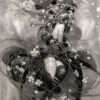
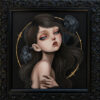
Phillip Thomas is a Jamaican artist recognised for his figurative mixed media paintings that blend realism and surrealism into a collage of multiculturalism. Whilst Phillip regularly uses oils within his works, each of his paintings also incorporates other mixed media elements including tar and bauxite earth. After Phillip graduated from Edna Manley College of the Visual and Performing Arts in Kingston Jamaica with a BA in Fine Arts, he would then receive a grant from the Cobb Family Foundation as well as a scholarship from the C.H.A.S.E Fund which allowed him to complete his Master’s degree at the New York Academy of Art.
Since graduating at the top of his class, Phillip has continued to explore important topics within his work including issues surrounding colonialism in the Caribbean, classicism, social identity, and the Old World versus the New World.
Phillip Thomas is currently represented by RJD Gallery. Please visit their website to see more of Phillips work and enquire about purchasing.
Interview with Phillip Thomas
Can you tell me a bit about what your creative process looks like? Do you have a routine that you like to follow?
A lot of my work is based on history, and the ways in which it affects the conditions that we experience today. Building a body of work around a particular theme or themes, may entail the necessary research that informs the scaffolding around the work. This research can take many forms, from deep dives into relevant texts, as well as excavations into film or even music, and even the everyday “banal” experiences can inform the process of art making.
The artists sensory perceptions are, in fact, very open and often times indiscriminate in its intake of information. This reservoir of experiences is then filtered through various methods of editing to create the template from which one begins the physical act of making. The ways in which artists work can be its own form of inspiration, separate and apart from the subject or content itself, the artists interest in materials for its sake can be research enough and that research can be put into form and put into practice.


Your work opens up a fantastic dialogue for topics such as culture, colonialism, and identity. Can you tell me about what first got you interested in these topics? Were these subjects something you were introduced to at an early age?
Growing up in Jamaica, my experiences create the kind of questions that fuel my work. One must understand that the Caribbean, and the wider “new world” for that matter, was shaped by the kind of cultural infusions, both civil and violent, that drives so much of our lived experiences today. Because we understand that our shared history shapes the way we craft our present and subsequent future, I have spent a great deal of time looking at the currents that drive our way of life.
Subjects such as Jamaican history is only one part of the subject of my expression. The process of art making for me, uses my incidental place of birth as a sort of template from which I can look at more national, regional and ultimately universal issues.
You have an interest in cross-cultural pollination, which is one of the reasons you completed your studies in the United States. Do you think that art is inherently cross-cultural and offers society that kind of pollination without us even realising it?
I studied at the Edna Manley College of the Visual and Performing arts in Kingston Jamaica, after which I pursued my MFA at the New York Academy Of Art. As you can imagine, studying art in these vastly different environments would have created the kind of cultural tapestry that still informs my work today.
These experiences create a method of art making that I simply find rich in subject and meaning. Issues surrounding themes such as emigration and cross-cultural fertilisation are subjects that are so pressing in our shared worlds. These themes aren’t simply contemporary subjects for me, but rather, they are historical patterns and loops that I have used in my work to create a “through line” between these various subjects. This method of using history as a kind of “material” creates works that aren’t simply a reflection of the “present” or the “current”, but it affords the audience a means through which they can see historical subjects anew.
What are some of the things you have learnt about yourself through your work as an artist?
There is a belief that all art is a “self portrait”. There is some truth to that, however, my ideas about art functions culturally. Many of the subjects that I am interested in are interesting to me simply from my own personal experiences. However, my singular perspective may be one aspect through which ideas are filtered, but I hope that I am able to incorporate points of view that may enrich my own perspective and create the kind of complexities that truly reflect how we all experience our shared communities.
One of the most profound things about art is that it does strive to communicate across culture and even time. Though there are slices of experiences based in a given point of view, those points of view become insight into experiences that are not of our immediate own. The fact that we can share these moments with people we may never encounter is a very meaningful thing for me.


Many of your paintings focus on the male form over the female form. Can you tell me a bit about what draws you to painting more masculine subjects? Do you find parts of yourself reflected within them?
It is true that a lot of my paintings do use the male form or archetype as a subject through which I can present the content. It’s partly my own perspective and then again these points of view are not uniquely masculine. Issues that are concerned with cultural dynamics, race, class and power are universal. It is true that we may experience these forces in different bodies, genders and sexualities, however, there are continuums that are constant and those ideas are, for me translatable.

What does the current art scene look like in Jamaica and where do you think your work fits into it?
The current scene on the island is vibrant. With various Biennales and national exhibitions I would say that the entire region is moving in the right direction. I’m in a unique position that functions between worlds. At times it can be beneficial to see ones own culture from a distance in order to see a more complete picture of our various art ecosystems.
Being on the board of the national museum of Jamaica as well as having spent time in education and other cultural development forums, I am able to see the broad arc of where Jamaican art is going, both locally and internationally. like so many other art spaces we have suffered a downturn during the COVID 19 pandemic, however, we have managed to maintain our various art ecosystems.


What do you hope viewers can take away with them after viewing your work? Is there a specific thought or feeling you want to leave them with?
Some artists produce work with the idea of being “understood” as part of the nature of the work. For me, art does not carry the sort of liner narrative that you find in some film or books, which creates the kind of “understanding” that may comfort some audiences. The production of an artists body of work over time is a kind of dialogue that is edifying in many ways.
Artists are able to reach various peoples where they are and have a shared or communal discussion that helps people feel seen and understood. It can be a powerful feeling to have a discussion with a stranger through and object and you can both share ideas or even have disagreements within the dialogue, however, dialogue must be the primary interface between the artist and the audience and whatever form that dialogue takes it must be fruitful for us both.

Phillip Thomas Social Media Accounts
Instagram | RJD Gallery Profile