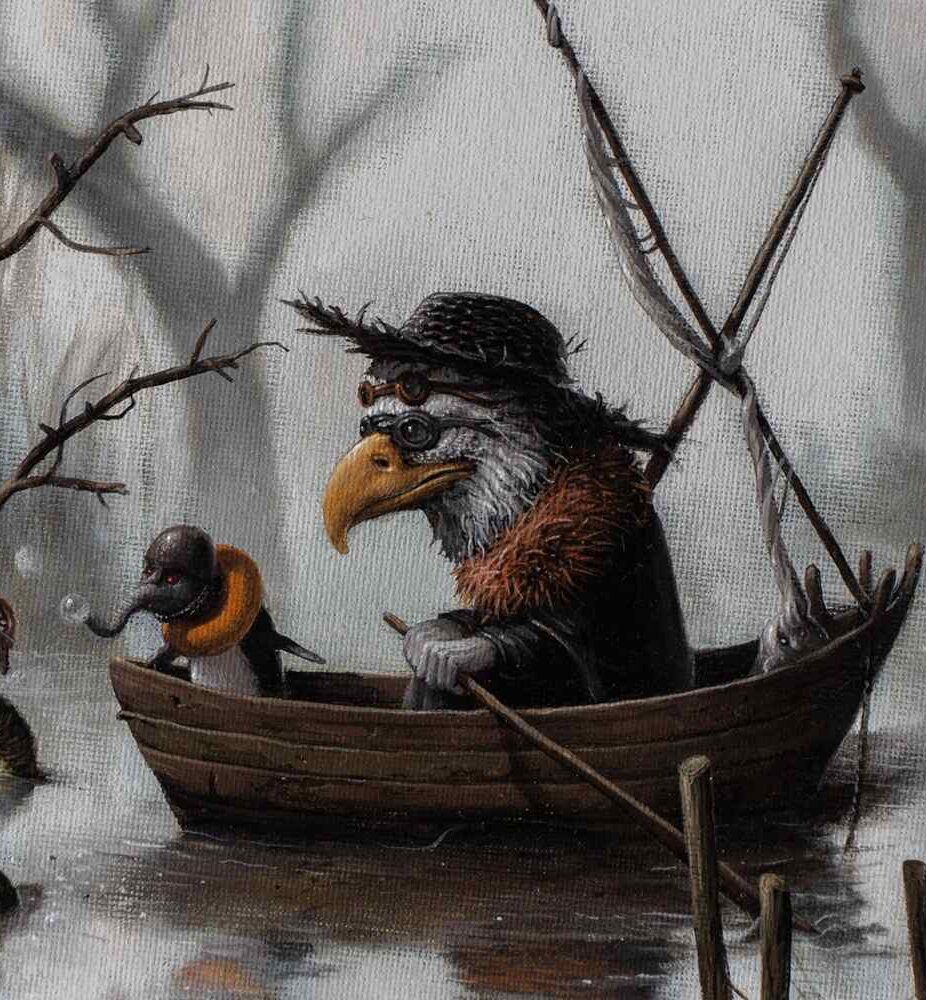
It starts with a vision; an impression permeating deep throughout the corridors of the artist’s mind and then evolves into a state of surreal exploration. In this imagined place we are transported and asked to dive deep into the many layers of the subconscious. We escape into the intricate, personal perspective as observers and leave entwined in the narrative as participants. BSMT Urban Contemporary Art Gallery, located in Dalston, London, invites you to discover the work of Stefano Ronchi, also known as Ronch, and his new solo exhibition “Invisible Lands” currently on view.
The tension of an unknown landscape, like a psychological fog you must cut through to find clarity, reveals a never sacrificing concept. Each glint of light, wispy cloud, blade of grass or portal to another realm refuses to be simplified while promising major sensory ignition.
We ask questions, we interpret the visual – we want to know more. And then we wait in hopeful observation that each painting will hint at an answer amongst the surreal anti-reality check permeating through the layers of paint. Join us in this discovery…read my exclusive interview with Ronch, alongside an insightful dialogue with BSMT Gallery!
Photographer credits for artwork, opening night and install shots by Zosia Kibalo.
Ronch, “INVISIBLE LANDS”
Exhibition Dates: October 16 – November 2, 2025
BSMT Gallery
529 Kingsland Rd, London E8 4AR, United Kingdom
+44 7944 857747
“Invisible Lands” is a cartographic dive into imagination: a meticulous exploration of shapeshifting landscapes and the peculiar characters who call them home.


Press Release //
At once absurd and profound, Invisible Lands charts Ronch’s ongoing fascination with discovery- both visual and psychological. Each painting begins with something he really wants to paint: an animal, a figure, a landscape, an atmosphere… and then it evolves into something else entirely.
This process, part observation and part improvisation, begins with a clear focal point:
…that circle of light glaring on a tree trunk in the middle of a forest, the shine of a farthest wave, the curved shapes of a dress, fire, smoke, and of course, sharks.
As shapes emerge, they spark questions. Why is there a squirrel here? Who is this figure in the distance? What are they holding? And slowly, worlds unfold.
The works in Invisible Lands draw the viewer deeper and deeper into their layered surfaces. Employing magnifying glasses as tools of both analysis and amplification, Ronch invites us to do the same- to examine each shape as a story, each canvas a miniature cosmos. What initially feels whimsical gives way to something far more vast, as micro-worlds begin to populate and reveal themselves in their intricacy.
There is an earnestness in Ronch’s meticulousness, a joy in detail, and an almost childlike refusal to accept reality at face value. These works are not mere paintings; they are territories, maps of the imagination. A long-time admirer of Italian author Italo Calvino, Ronch pays homage to the spirit of Invisible Cities -where imagined landscapes mirror internal truths, and the surreal serves as a lens through which to examine the real.
INVISIBLE LANDS will open with a private view on Thursday October 16th, from 6-9pm, at BSMT Gallery. Drinks for the evening are generously provided by our friends at Jubel Beer.


About the Gallery //
Situated in the heart of Dalston we continually work towards curating a space that connects The Street to The Gallery, a gallery space galvanised!
Born in 2015 out of a disused black basement with the aim of gaining recognition for emerging talent, the gallery has steadily expanded its reach and diversified its projects, gaining a reputation as a platform that now showcases some of the finest emerging and established UK-based and global artists. Through our active exhibition program we have consistently pushed the boundaries, contributing to the cultural enrichment of East London and solidifying the merit and talent of the diverse roster of Artists we represent across Urban and Contemporary art.
We are now ‘ground floor’ but our goals as a gallery remain the same: the support and development of emerging and established artists, to use the gallery to support causes we believe in and to allow the gallery to be a place to create as well as to exhibit. Our roots in the subcultures of Graffiti and Urban Art have ensured we continue to produce authentic exhibitions offering audiences an alternative and refreshing view of the Art World.

Artist Statement //
The main feature of my work is the meticulous attention to detail in microcosms crowded and dense with situations, through a miniaturist approach, supported by the use of a magnifying glass to define every square inch of the painting.
Urban contexts are dismembered in a dream-like swarm of architecture, forms and social relations are disrupted, provocatively juxtaposed with no apparent order.
Childhood memories and paranoid nightmares are recomposed with graphite or color on canvas and paper, often through pareidolia, returning a duel between the freedom of the absurd and arbitrariness of the rule.
A butterfly in the bin. Paradoxes, ugliness, drifts of our social system hidden inside the simple beauty of things. If you have the time to see this in my paintings, then you have the time to see it in real life. Think, act accordingly. Stay punk-surrealist.


Exclusive Interview with Ronch
“Invisible Lands”, immediately piques the curious viewer – the magnifying glass seems to be your armor, your tool for precision and paradox. What internal truth did you discover about yourself in the intricacies of this collection?
A painter I have been admiring for ages, Agostino Arrivabene, maybe in 2012, in his studio, introduced me to this tool. I have been using a lens (a visor now, as I need both hands to work) since.
Most of the time it is more of a tool that helps with exploration, allowing me to capture smaller shapes that might tell a story. The devil is in the details and I am trying to catch it… so I can finally sell my soul!
I would also say that it makes my life easier, even if the process gets a bit slower, as volumes become bigger through the lens, textures more visible, and so on. Internal truth? The truth is unreachable, as the details may expand to the infinite, like a romanesco broccoli.

Which part of your paintings are laid down with the most certainty, and which elements act as the catalyst that forces the scene to change its mind?
Well, I would say that it really depends: as a painter I am interested in everything, I am very enthusiastic and optimistic even when I look at (or into?) a dirty wall full of smudges.
When I start a painting it is because there is an image somewhere that is screaming for attention: a place, a figure, a paragraph from a book, a light… This is the starting point. I draw around that idea until I have found a story: main characters, time of the day, background, etc. Then I start to look for references, from the internet, from my window, or from life, it depends.
Other things that I always plan in advance are basic composition guide lines, perspective and “lighting system”.
After the above, shapes are in charge of where they go.
As characters and concepts emerge, the whirly mind asks “why is this here?”, “who is this figure?’. How do the answers you get from the paintings fundamentally change the conscious intent of each piece?
There is probably little “conscious intent” in what I do. Rather, there may be more “conscious interpretation” of shapes and their relations on the canvas. Maybe it is something similar to divination, the interpretation of signs, not sure. Once a doctor asked me what I saw in Rorschach smudges: it took me 35 mins to explain what I saw. The doctor cried.
As they emerge, characters themselves could change almost everything, drastically sometimes: the story could mutate multiple times as the painting progresses, even the time of the day could change. The coolest part is that characters can influence other paintings too.


Nightmares and memories, what do you believe is the most challenging real-world fragment you have integrated into “Invisible Lands”?
Mmh, ok. Painting is for me several things, therapy is one of them: I can throw everything out on a canvas, memories and nightmares, fears and dreams. And then look at them, point a finger at them and show them to people.
In the end, for me nothing about painting is really challenging emotionally: painting is more of a relief, the real world is challenging.

If your process is a map of imagination, what happens if you reach a dead end? Do you paint through it to redirect a new, truer destination?
Not sure about this. What is a dead end anyway? Let me tell you this: I always think “how cool was Malevich with his black square” whenever I reach the maximum level of zoom in photoshop, the atom, the romanesco broccoli… Maybe this for me could be a dead end: a black square, a prison with no shape to play with… I have not seen it yet, fingers crossed.
How has the unseen, intuitive part of your journey asserted itself into your body of work?
The journey asserted itself, spontaneously, unplanned, following my aims, my heroes, and this is one of the many reasons why I love painting. It is like an endless PhD, where the goals could change unpredictably. Now I look at David, Caravaggio and Bosh, before there were Dali, Giger and Klinger, and before them, illustrators who painted the covers of Disney’s movies in the early `90s, when I was a child.
The same happens with music, as musicians have the same influence on me as the painters do, sometimes even more.


When the last piece of “Invisible Lands” was complete, what was the greatest secret of the creative process that revealed itself to you?
I think the secret reveals itself half way through the work, actually. People nowadays have AI assistants. I have been using my unconscious as a personal assistant since I was 14. I call him the “lazy guy who lives inside me” and most of the time he comes out with stuff, ideas, ways to avoid other things, etc.
While I was working on a few paintings without any general plan, one day I looked at them together, and the “lazy guy” whispered in my ear: “that’s a dump… rubbish” and I thought: “you are right, man”. So I started to work more on that, the rubbish theme, and the idea of catching beauty in the little things that might be hidden inside the dump. I used this sentence before, I was looking for “the butterfly in the bin”. And I still do.
And… If you put yourself in front of a magnifying glass, what would you see?
Well… I see a smudge… wait, it looks like a squirrel… What is she doing there?! …oh gosh, here we are again.

BSMT Gallery Questions with Gregory Key and Lara Fiorentino
Considering Ronch’s “Invisible Lands” as a ‘dance between reality and imagination’, did your curatorial approach for this collection focus more on amplifying the sharp observation of the initial focal point, or the chaos of the psychological evolution? Was the goal to blend both sides of the dichotomy?
Each piece is steeped in a miniature narrative of its own. What has become particular to ‘Invisible Lands’ is how the viewer is compelled by the works, ‘drawn in’, revisiting their favourite again and again as it reveals itself like the layers of an onion.
Similarly, what was the most critical logistical decision BSMT had to make when considering flow and sequence of the finished works upon entering the gallery space?
While you can curate the exhibition by guiding the visitors through the space with colour or lack thereof, or by the position of a larger scale piece like ‘The Island’, which commands attention, you cannot control the magnetic quality of the work and as such the exhibition has curated itself.
BSMT Gallery Social Media Accounts
Website | Facebook | Instagram | X