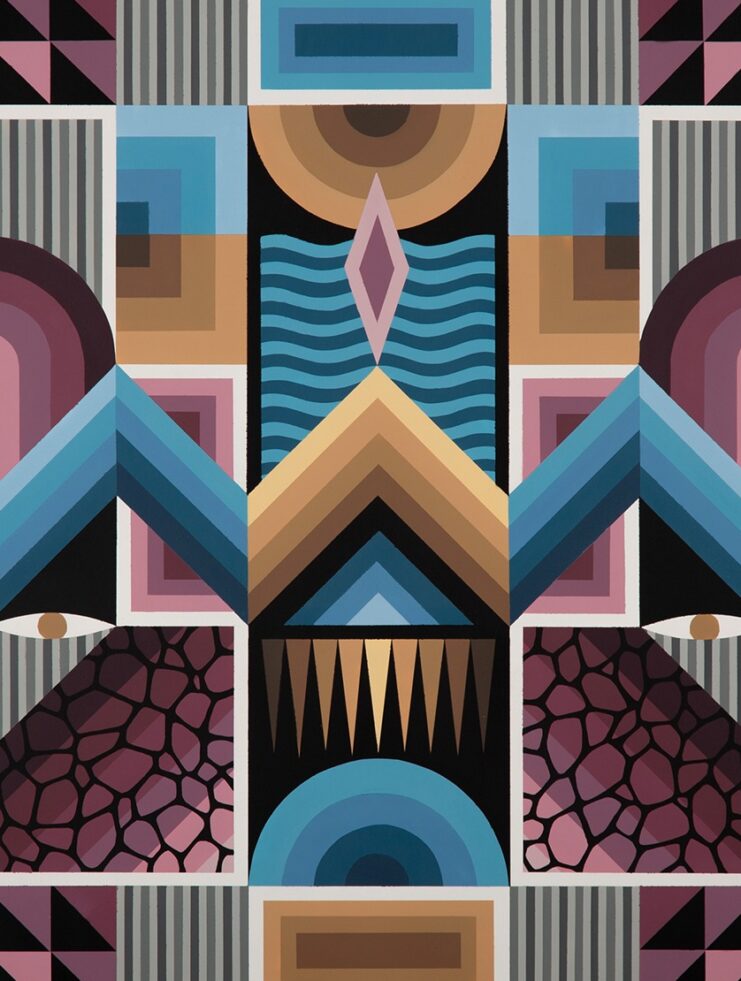
Outré Gallery is proud to present ‘Complex’, a brand new solo exhibition featuring the intricate surrealism of Bradley “Beastman” Eastman. Continue reading to learn more about this upcoming exhibition as well as a brand new interview with Beastman, originally conducted by Mel Parker for Outré Gallery’s website.
Artist bio:
Bradley Eastman (Beastman) is a multidisciplinary artist from Sydney, Australia.
Influenced by the biodiversity, symbolism and design aesthetics of organic growth patterns and natural landscapes, Bradley’s vibrant and energetic paintings, digital illustration, commercial projects and public mural artworks explore a unique visual language, depicting future environments of abstracted geometric landscapes, potential new life forms and human intervention with nature.
A distinctive and prolific contemporary Australian artist, Bradley has exhibited his artworks extensively around the world, has curated and produced numerous international art exhibitions and projects, and has created commissioned artwork for clients such as Facebook, Mini, Hyundai, Apple, Westfield, Adidas, Red Bull, Stockland, Marriott, GPT, Vicinity, Merivale and more. His artwork has been acquired by the National Gallery of Australia, and his large solo and collaborative mural and installation works can be found all over Australia and around the world.

‘Complex’ by BEASTMAN
Exhibition Dates: 12 Jun – 5 Jul 2026
Opening night: 6–8pm on Friday, 12 Jun 2026
Drinks provided by Range Life Wine & Bodriggy Brewing Co.
Outré Gallery
319 Smith Street, Fitzroy
For more information on the exhibition including viewing and purchasing online please visit their website or email the gallery at info@outregallery.com
Artist statement:
This ongoing series of paintings explores the intricate relationships between human life, natural landscapes and the built environment, not as separate forces, but as interdependent systems in constant exchange, expansion and collaboration. Years of refinement underpin this visual language. Gradients of colour, measured grids and precise compositional frameworks converge to construct balanced visual fields pulsing with the spirit of life.
Repetitive motifs and evolving substructures accumulate and combine, forming complex networks and futuristic landscapes that suggest growth, movement and connection. While each individual artwork operates within carefully considered parameters, the paintings collectively hold a tension between order and vitality, between architectural precision and organic expansion, reflecting the energy of the city itself and the natural landscape that once was.
Eyes appear embedded within the compositions, encouraging viewers to reconsider the urban landscape not as static infrastructure, but as a living system shaped by human intention, emotion and experience. Working predominantly with aerosol paint, a medium that requires confidence, control and physical intuition, each painting is built through patient masking and layering, a process developed over years of installing large-scale mural works. Subtle imperfections remain visible within the surfaces, affirming the artist’s hand and the delicacy of the medium, while acknowledging the impossibility (and perhaps undesirability) of perfection.

Interview with Bradley “Beastman” Eastman
Interview by Mel Parker. Images supplied by Bradley Eastman.
Your upcoming show is titled Complex. Can you tell us why you chose this title and what our viewers can expect from this upcoming body of work?
This body of work is something that I have developed over the last few years; the paintings are mostly formed through a grid construction design process that enables the artworks to partially construct themselves through various parameters and systems I have formed to create geometric compositions that are made up of repetitive patterns, elements and colours. This series of paintings all have similar palettes and structures, so viewers can expect to be immersed in or surrounded by the artwork as a whole, as if they are inside an urban complex of buildings, pathways and human designed nature scapes. The title refers to the complex networks of man-made structures and spaces we design and build to enhance our own human experience and our relationships with the natural landscape. The artworks do intentionally look visually complex, to further express the current state of human society and the way we live today in regard to our impact on the landscape and environment.
I would say ‘complex’ is a pretty accurate description of a lot of your pieces – not only visually but regarding the concepts behind them, particularly the idea of future environments. Can you tell us a little more about this idea and what draws you to exploring it? Has this been a long-running theme in your practice?
Over years my works have leaned more and more into exploring landscapes and natural environments, and then further into our human experiences and how we interact, collaborate and intervene with the landscape, in both positive and negative ways. I love architecture and landscape design, and I also wonder about what our future environments could look and feel like. This interest I do think developed when I was younger through my passion for skateboarding and photography, and then exploring the urban landscape for places to skate and shoot photos.
My artwork style from a young age always steered toward creating various characters and lifeforms, and part of me never wants to stray from that, so my works in recent years really have been about exploring how can I breathe life into these structured futuristic landscapes – so the resulting works I create are like an abstracted blend of both landscape and lifeform – as if these conceptual spaces are alive themselves.


How do you approach a body of work like this? Are you the kind of artist who has a few pieces on the go, or are you a one artwork at a time kind of creator?
I always approach a body work as one artwork created in pieces. Essentially all of the paintings are the same artwork, broken out into different sub-paintings. I like to develop a design process first, and this is the main core of the body of work; the artworks are then derived from the design process and the library of patterns, colours, motifs, elements, symbols and frameworks that are locked into that design process. I developed this square grid process of building compositions a few years back whilst working on an interactive exhibition for Sydney Museum titled Playscapes, and I loved the process so much I dived a bit deeper into it to form these works over the years to follow. I have also painted a number of larger mural pieces using the same design process.
Your practice spans a wide range of projects, from murals and installations to workshops and commercial partnerships. Did you always want to take your work in so many different directions, or did you envision things differently when you were starting out?
I never envisioned anything when I was starting out, was just enjoying making drawings and paintings. When I was younger I really enjoyed exploring all different ways of just being creative – drawing, photography, filmmaking, design, illustration, painting, typography – everything. So I have never really applied any limitations on where I can take my art practice, I have just let it evolve over time based on the varied opportunities that came my way. I enjoy the challenge of constantly evolving my artwork and having it look cohesive and distinctive in its style no matter what project I am working on.
Looking back, how do you think your practice has evolved over time?
My practice has evolved so much over the last 20 years or so; the biggest change over that time would just be my personal approach to making art, or for what reasons I was actually making it. I used to be a lot more free with my expression – I would just make something from nothing, with no preconceived concept or meaning or agenda, it was just the style that would output whatever it happened to at that time, purely for the sake of creating an image. This was enjoyable, but over time it became far more important for the work to have a higher purpose, an underlying idea or directive.
The biggest change in my practice came when I began to paint mural works with aerosol paint, this would have been around 2008, almost 20 years ago now. The medium enabled me to work at a much faster pace with vibrant colour, so this made the process of refining my style and finding direction move much faster as I was able to try out different patterns, colours and concepts quicker than with any other medium. I then went about painting hundreds of paintings and collaborating often with other artists also, this combination of collaboration and the aerosol paint as a medium helped my work evolve at a much faster pace. I quickly became much more confident with my artwork and my style, and found core themes, parameters, directives and long-term concepts that my work expresses still to this day.


Were you always creative? What are some of your earliest memories of making art, or early creative influences?
Yeh I think I have always been creative, I remember just always drawing on everything, especially during school. I also was very into skateboarding from a young age; I think this pushed me to be a more individually creative person. The DIY aesthetic and creative culture that surrounds skateboarding encouraged me to get involved in making art and take lots of photos, so I always just let the culture take me wherever it wanted to lead me.
As a child my early influences in art were comic books, Japanese animation and also MC Escher. My parents had a couple of Escher posters in our house. Then into my later teenage years it became artists associated with the skateboarding industry that really inspired me to make more art – Ed Templeton, Evan Hecox, Jim Houser, Barry McGee, Mark McKee and Don Pendleton.
What does a typical day in the studio look like for you? Do you have any rituals or habits that you engage in to get the creative juices flowing?
For many years now my studio has been in our house, so my usual days somewhat revolve around the family and what’s going on with the kids and my wife. Most days I would get the kids to school then just get stuck straight into whatever was happening that week. I would usually just get a five hour window of time to try get as much work done as I can whilst my boys are at school. I don’t have any rituals or anything to get it going, I feel like once you just start something, you go and go until it’s completed.
I don’t have as much time to procrastinate anymore; I’ve got to make the most of the time I have. Most of my time is spent on the computer these days. I like to create a lot of my concepts, mockups and designs digitally – it has become faster and more productive for me as I have slowly developed design processes that are more suited to digital illustration. Even with my paintings I tend to create compositions first with pen on paper, then build digital graphics from the basic sketches, and then I would paint it once I have a plan. I do like to listen to music when making art and painting also, good music helps get me into flow state for sure.


You have quite a unique style – how do you stay true to yourself in a world that can feel pretty chaotic?
I think this is the ultimate challenge for any artist, this pressure and desire to continually evolve your artwork – essentially attempting to make it better and better – whilst still remaining true to your original style and what you have made in the past. I like to think that I haven’t yet made my best work, it’s still to come.
My work will always be some kind of mashup blend of everything I have done in the past, with some new element thrown in the mix – this element could be anything, a medium, subject, theme, process, design brief or location. I try not to look at much of what other artists are doing and just focus on my own projects and what I am currently making. Many years ago I was also able to stop caring about what people think about my artwork, this helps a lot when it comes to staying true myself and what I’m making. Basically if I like it, then it’s good! And I will put it out there for people to enjoy (or not).
Is there anything you haven’t done artistically that you’d love to try?
Yeh for sure I’m always open to trying new things. I have some ideas for large scale sculptures and landscape interventions that would be great to explore. Hopefully some opportunities come my way over the coming years that enable me to explore these and potentially make them happen.
Finally, any exciting projects on the horizon you can share with us that you’re particularly looking forward to?
I have a few public art projects happening in regional towns over the coming months including a permanent ground art installation in Geelong and also a wide format mural in Port Macquarie. I love taking my artwork into regional areas of Australia, so I am excited about these opportunities. I’m also working once again with the team at Ramus Illumination on some content for a new lighting sculpture installation in Hong Kong.
Recently I have also found a desire to potentially curate some exhibitions or projects again, I used to do a lot of this with weAREtheIMAGEmakers many years ago, and some recent events in my life have encouraged me to think about doing something to bring artists together to push their creativity and raise awareness for a worthy cause. Will likely also do a couple of print releases this year also – if anyone is interested, they should join my mailing list on my website to find out about my releases and other projects I am working on.
BEASTMAN Social Media Accounts
Website | Instagram | Facebook