Classical art holds a special place in many people’s hearts, mine included. The classical genre is a time capsule of centuries past. It’s a brief moment captured on canvas of great creative minds and of painting subjects who captured imaginations who now find themselves immortalised. It is the foundation of the artistic consciousness as we know it today and is a genre that deserves to be preserved and treasured.
Stéphane Pannetier Le Hénaff is keeping the classical genre alive and well through his collections of paintings and drawings. His work offers viewers a chance to step back in time and enjoy the timeless styles of religious imagery, traditional still life and live model drawings inspired by the likes of da Vinci all with the inclusion of a marvellously modern twist that would have once been considered sacrilegious. So join Stéphane as he keeps classical art alive, without any of the stuffiness.


Stéphane Pannetier Le Hénaff is a French artist who works in graphite, inks and oil paints to create figurative paintings and drawings that emulate a feeling of classical paintings of centuries past with a modern twist. Born in Avranches, Stéphane currently resides in Fleury-sur-Orne, France. He has a formal education in the arts having studied at École des Beaux-Arts de Montréal, the Barcelona Academy of Art, and the German Academy of Art.
Stéphane specialises in creating portrait paintings and drawings using live models and has been exhibiting his work since 2015. His current body of work consists of two projects; his Wild Flowers series which utilises graphite and inks alongside The Saga of Pandora’s Box, which utilises oil paints. In February 2025, Stéphane joined Toolip Art Gallery’s artist roster where he currently sells both original works and Hahnemühle fine art prints and he is also a member of the Beautiful Bizarre Artist Directory.
I love seeing a smile from the public when people view my artwork, it is something special to be able to share a feeling with people and that’s where art is the natural light that connects souls together.
Interview with Stéphane Pannetier Le Hénaff
What is your earliest memory of art?
As a child, I discovered the Van Gogh Museum in Amsterdam and I discovered that the richness and often oversaturated colours mixed with the strength of expression petrified me. I found this to be an unforgettable experience and it was my first awakening and acknowledgment of oil painting.


Your body of work feels like an ode to classical art but with a modern twist. What do you think of this interpretation? Does it align with how you see yourself artistically?
Indeed I do agree, my paintings have a touch of modern salt within a bowl of classical painting soup. As a self taught artist I began my career at the age of 19 and started by learning abstract art, then semi figurative before eventually learning to draw and paint in the classical style before moving on from painting in a direct style to an indirect style. All of these moments in my artistic journey have laid the foundation of my current painting style and I believe that the modern touch within my work comes from my self-taught side where I’ve reformed the established rules.
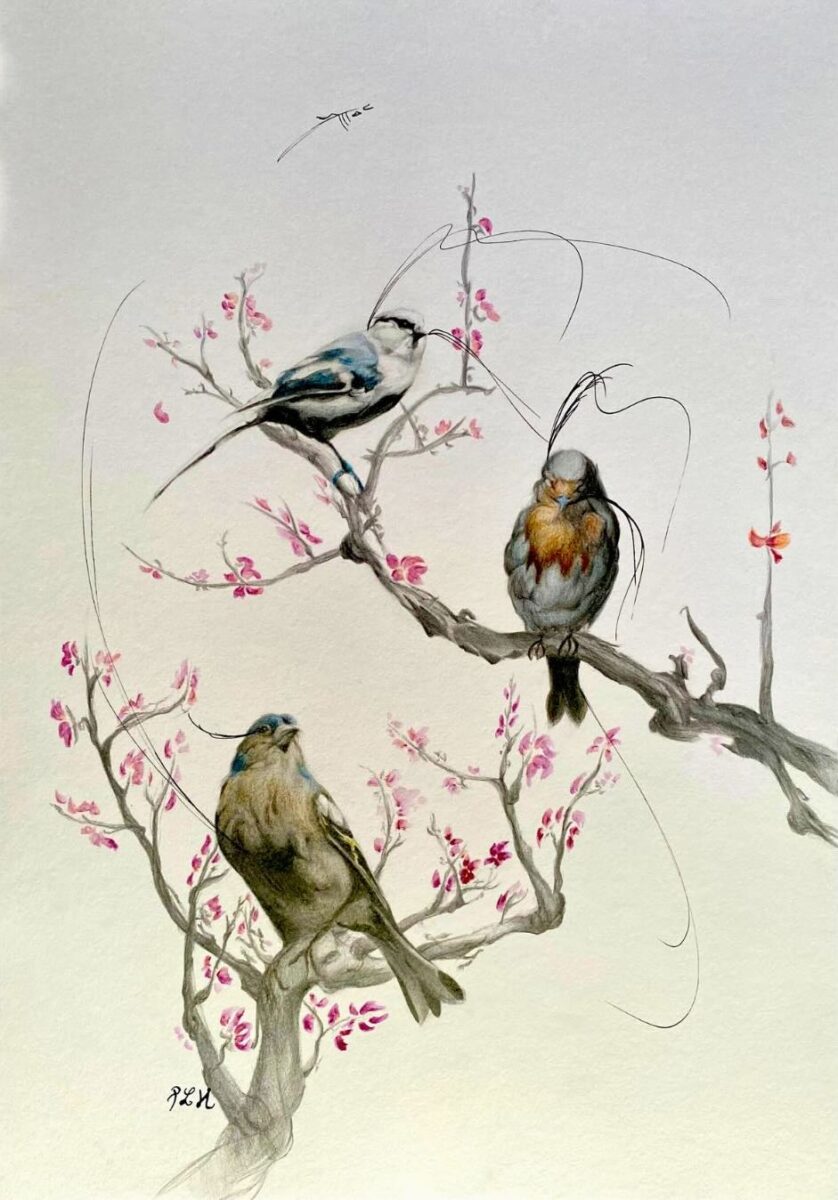
In my drawing we find a figurative style that is closely linked to the style of the 16th century, in which I express a sweet feeling alongside mixing in a few arabesques that lengthen the gestures of the figures and transform the drawing into something that mixes abstract, classical and modern styles. I tend to limit this touch of modernity in my illustrations. For me, drawing remains above all an unfinished idea, where it’s possible to interpret whilst suggesting that more could be included which ultimately leaves space for the viewer to become emerged in the drawing and its rhythm.
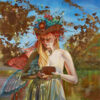
In my Pandora’s Box Saga, I experiment with an interpretation to portray memories of a subject, both in a classical sense by keeping the relationship between the colours that appear on the painting (a so-called indirect painting), using glazing and sfumato to express a feeling of softness, whilst mixing a modern look by superimposing points of view that becomes more and more transparent, allowing for a feeling of movement and memory within the scene.
Can you tell me a bit about the artists who have inspired you and why their work resonates with you?
I think the drawings from my Wild Flowers Collection (Fleurs Sauvages) were heavily inspired by Gustave Klimt, especially his artistic language in his golden period alongside Alphonse Mucha with his bewitching Art Nouveau illustrations. Modern day artists such as Miho Hirano and Yoann Lossel also inspire me, especially the symbolic relationship and figuration within their own styles. Many of my drawings have references from both of them.
When discussing my paintings, I would say William Bouguereau inspires me for his use of colours which I borrowed in my painting ‘L’espérance’ (Hope) opus one of the Pandora’s Box Saga. Michelangelo Merisi Caravaggio inspired opus three ‘La folie’ (Madness), Odd Nerdrum’s relationship with colour, especially his apelles palette was partly borrowed in ‘La Mort’ (Death) opus two.
Each of the masters are always great to contemplate again and again; Pierre Paul Rubens, Diego Velázquez, Tiziano Vecellio, Michelangelo Merisi Caravaggio, Ilya Répine are, for me, all sources of inspiration in their subjects, colours and compositions. But Leonardo di ser Piero da Vinci remains my beacon in the night for his expressions of sweetness, for all the subjects, the compositions, the relationships between colours, the pretexts and the way the artist both hides and reveals his ways of thinking, like a spiritual door of love.


Pandora’s box, nature, women and spirituality are all important themes within your work, what is it about these subjects that you find to be so fascinating artistically?
I think these are themes that can be found everywhere in our lives and I will only paint things that I can see, love, and have at least some knowledge of. In Pandora’s Box, I reflect on the darker tones of life while in my Wild Flowers series, I prefer to see the light and explore interconnected ideas between nature, women and spirituality. To me, these subjects more importantly fuel the feelings and memories that are expressed during the creative process.
Are there any other subjects or themes you have yet to explore within your work but hope to in the future?
I find myself wanting to paint all kinds of subjects, ones that are possible and also those that are impossible. I’m still young and so I hope I have enough time to finish my Saga of Pandora’s Box. I’m nowhere even close to finishing my Wild Flowers drawing collection as each drawing and subject is a game to play and conquer in itself and if something is wrong with the piece, I can only blame myself, before continuing my painting and drawing journey. It is never perfect.
What do you find to be the most rewarding aspect of your work as an artist and why?
I love seeing a smile from the public when people view my artwork, it is something special to be able to share a feeling with people and that’s where art is the natural light that connects souls together. Art is magic in that aspect.


What is the most challenging aspect of your work and why?
Firstly, I think the fact that art styles evolve, so pictorial art in a previous style is no longer of itself but instead feels of another artist which can provide a real feeling of disappointment. When I look back at my old works, I often find myself falling back into memories of those moments lived in a previous time in my life which does make me feeling a little nostalgic.
I would also say loneliness is another challenging aspect of my work. Fighting alone not against someone but face to face with the painting. The white canvas has never surprised me, but it is rather the challenge of getting where I want to go with my work. There is a certain perfectionism between my final vision and the concrete reality of the game between the artist and the work so that the interpretation is a perfect balance between the vision and the final rendering that must be achieved without a trace of the coarse brush, which can make things feel relatively lonely.
What’s next for you? Any exciting projects and/or exhibitions coming up that you can tell our readers a bit about?
I’m currently working on my first art book of drawings and paintings, my first calendar which will release for 2026, a new film documentary film in collaboration with GAAP studio with Guillaume Pannetier (after my first one is “L’enfant indigo” by Julien Granet at StudioVAC). I’m also working on releasing some more fine art prints.
In 2026, I will be working on some more paintings for the Saga of Pandora’s Box including ‘Ego’ with the mirror, ‘Passion’ opus five and ‘Old age’ opus six using a live model. I will also be looking for a new larger art studio to work in to close out the last opus of the series.
I would also like to invite readers to visit Vienna Toolip Art Gallery where they can discover my Saga of Pandora’s Box and Wild Flowers collections which are accompanied by nine ultra limited fine art prints. Many of my works will feature in Toolip Art Gallery’s exhibitions including ‘Nature‘, on until 24 October, ‘Art Will Save Us’ (31 October – 21 November), ‘Requim‘, a tribute to Mozart (29 November – 21 December) and ‘Upside Down‘ (2 – 24 January 2026) where I’ll be unveiling some new pieces within my Wild Flowers collection. I’m also exhibiting at Espace Nicolas Oresme from 5 – 7 December as part of their ‘Passages‘ exhibition.