The below exclusive interview with Megan Ellen MacDonald was originally published in Issue 48 of Beautiful Bizarre art magazine. Get your copy: print magazine, digital magazine.
Femininity, on the surface, looks like any other normal set of attributes that have been thrust upon many of us from an early age. It suffocates us with its ideals, reciting its values to the point of rejection and madness. Femininity must be cute, kind, and non-aggressive. It must be submissive, helpless, and emotional. It must be the perfect homemaker and a baby machine on tap. It must be grateful and under no circumstances must it ever answer back to its perfect husband. Under the guiding light of the patriarchy, femininity would never bite the hand that feeds it; but what if it did? What if this version of femininity was all just a guise to hide its true nature? A nature of girlhood plagued by the horrors of their own bodies as they slither and squirm like spiders to satiate their sexual appetites all while using their sweet femme wiles to their quiet but deadly advantage. Megan Ellen MacDonald captures this nature and showcases what femininity really is, in all of its truly horrific and uncanny beauty, and honestly, it has never looked cuter.
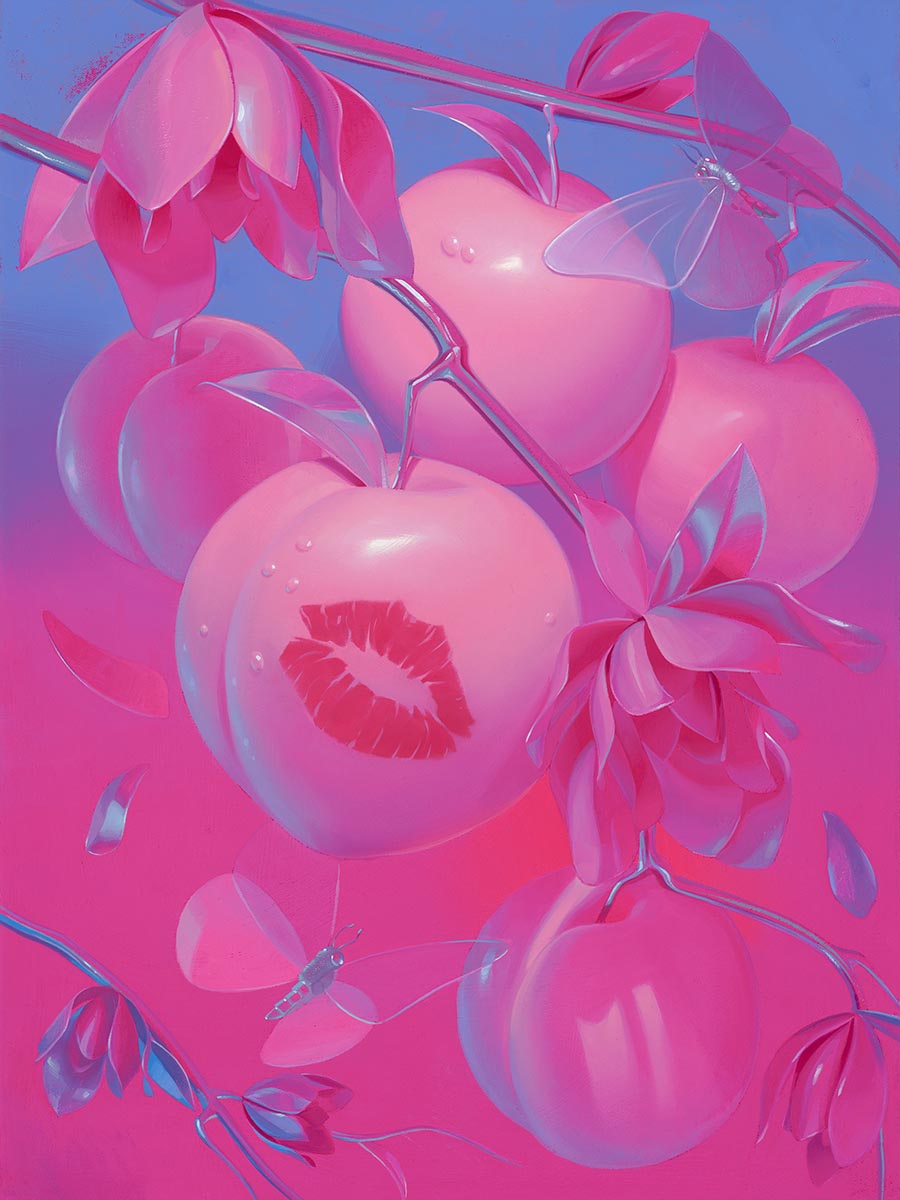
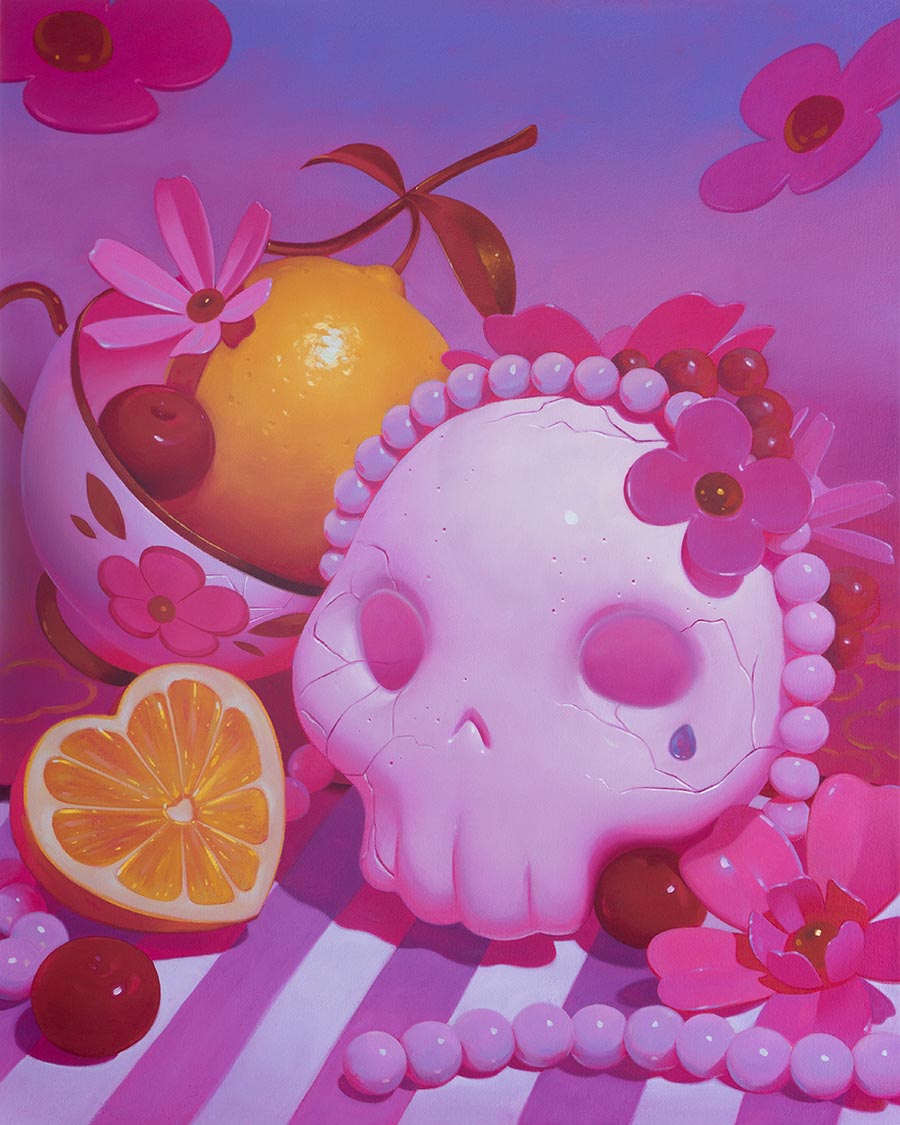
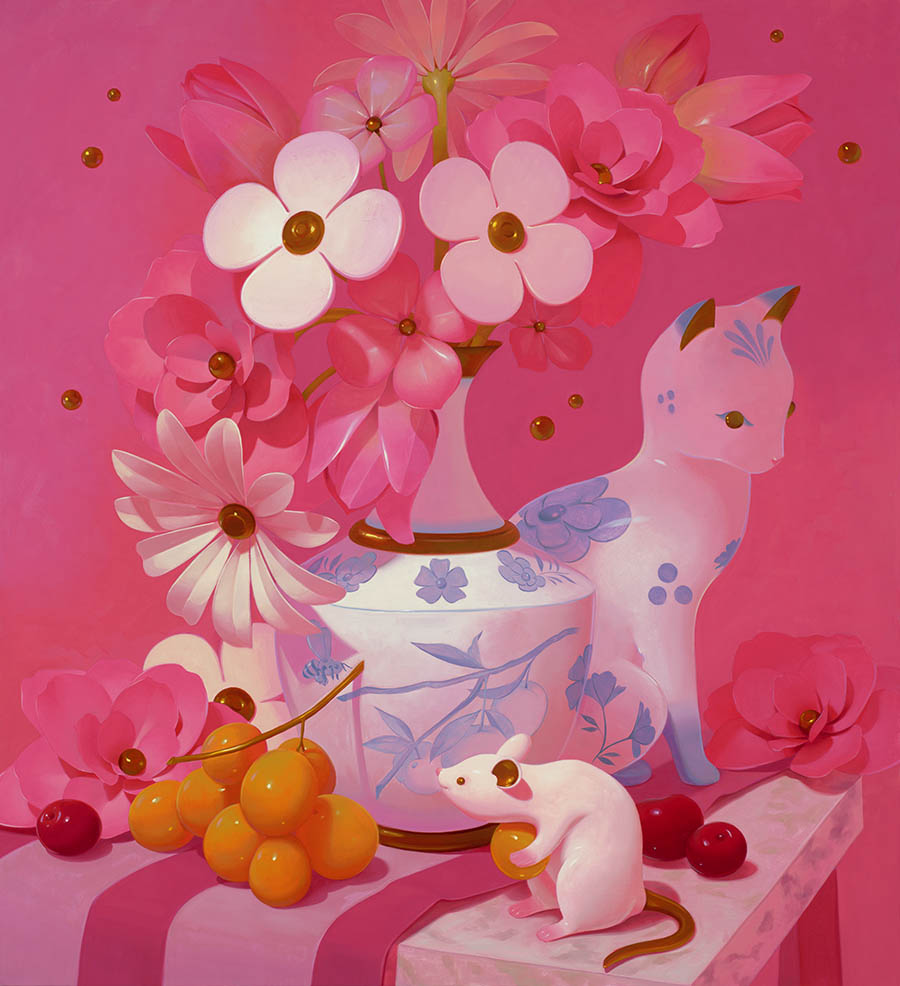
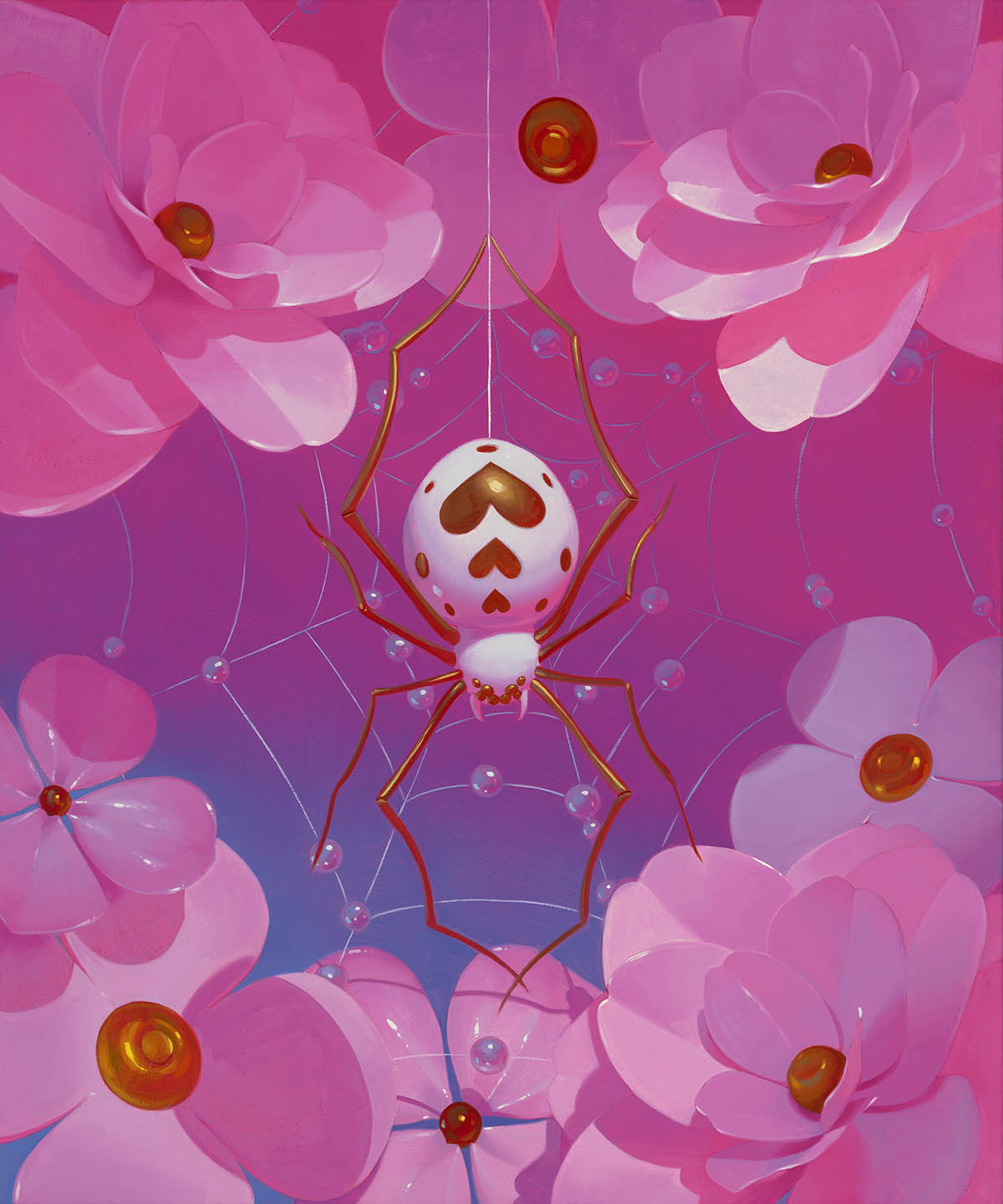
Megan is a Canadian oil painter based in Toronto who explores the complex nature of femininity through a kitschy, hyper-feminine lens. After graduating from Ontario College of Art & Design University in 2013 with a BFA in Painting and Drawing, Megan has explored various themes all in conjunction with the kitsch aesthetic. While previous years saw kitsch paired with the theme of memento mori and the commodification of the sublime, her current body of work packs an even harder punch set on deconstructing gender stereotypes. Through a unique painting style that utilises both traditional and digital mediums, Megan reclaims the stilllife, a genre that once restricted female artists, is now stripped of its patriarchal gaze offering a fresh perspective on themes of power, objectification and cuteness. Death plagued flowers, hungry animals, and sexually charged fruits are all rendered using 3D software before being transferred from computer to canvas to be completed in oils with a glossy sheen that places her works somewhere between our realm and the digital space.
Who do you paint for?
I paint for anyone who finds a connection with my work, but I have always painted for myself, and that is something that informs my practice as an artist. As someone who finds it very challenging to verbally express myself, visual art has been a way for me to express and make sense of how I see the world. Art has always offered me an escape from the dullness of reality, and the ability to create alternate stories and places that feel safer and richer is one of the biggest draws for me. The work I create now is still deeply personal – a reflection of my experiences, identity, and ideas. It is a space where I explore themes that are relevant to me, like femininity, power, and mortality, while also creating something visually captivating and conceptually rich for others to engage with.
Your work primarily explores themes of femininity, what does femininity mean to you and how do you interact with this aspect of gender?
For me, femininity is both an aesthetic and a powerful act of reclamation. It is something that has long been dismissed or undervalued in art unless it conforms to or at least acknowledges the male gaze. My work challenges this by embracing hyper-feminine aesthetics to reframe femininity as a source of strength and complexity. My work is bright, kitschy, and unapologetically “girly” – all the things I rejected in my girlhood because at some point I realised a certain brand of femininity was being pushed on me, but in a way that stripped me of my power. I don’t want my work to respond to the concept of the male-gaze or aesthetic hierarchy, or even reject it. In my mind, the work I create doesn’t even acknowledge its existence. It’s about carving out space for the feminine experience, reclaiming it, and exploring its depth.
“For me, femininity is both an aesthetic and a powerful act of reclamation. It is something that has long been dismissed or undervalued in art unless it conforms to or at least acknowledges the male gaze. My work challenges this by embracing hyper-feminine aesthetics to reframe femininity as a source of strength and complexity.“
What are some of the ways in which you have reclaimed your femininity?
Reclaiming my femininity has been a deeply personal journey, and my art has undoubtedly played a central role in that. I will never forget the moment one of my university instructors curiously said “you paint like a man” in a critique. I don’t think it was an insult, or a compliment, but maybe they could tell I was trying to fit myself into a box I did not really want to be in. Either way, it made me consider why I was rejecting femininity as part of my identity and wonder how I could reclaim it without restrictions. Through my work, I explore hyper-femme aesthetics like soft pastels, florals, and delicate textures, not as symbols of compliance but as acts of defiance. Outside of art, I have also embraced femininity in more personal ways like how I dress, or small acts of self-care that are unapologetically “girly”. I like to inhabit duality and be unafraid to embrace femininity while rejecting the expectations of behaviour that come along with them. These acts aren’t just aesthetic; they are about reclaiming a space for myself that was once fraught with societal expectations. It is about finding joy and empowerment in something I once viewed as limiting.
Your painting process starts digitally before being transferred to canvas to be completed in oils. What draws you back to traditional mediums over keeping your work digitally streamlined?
There is a tangible magic to traditional painting that digital mediums can’t replicate. Oil painting, in particular, allows me to explore texture, depth, and light in a way that feels deeply intimate and meditative. Digital art lacks physical depth because it is just light on a screen. Paint offers the ability to layer colour and manipulate the
eye in a way digital presentations of the images simply can’t replicate. While the digital stage lets me play with my ideas and composition freely, and more specifically sculpt, oil painting grounds my work in the physical world, creating a tactile object that invites viewers to linger and engage with the materiality of the art.
Since your work utilises both digital and traditional mediums, can you tell us about your creative process?
The process begins with 3D modelling, where I design and compose the subjects and environments. I previously worked directly from still life arrangements, but extending this methodology to 3D has allowed me to explore textures, materials, and light in a very experimental, playful way. With 3D, I also never have to deal with rotting fruits or wilting flowers. Once I’m satisfied with the digital composition, I use it as a reference for my oil painting, similar to how I would use a still-life arrangement. On canvas, I bring in the physicality of brushwork, layering, and colour to create the final piece. This hybrid process pushes the images towards the uncanny, while still grounding them in the familiar presentation of oil painting.
You mention your process pushing the image into the uncanny, what is it about the uncanny that resonates with you?
The uncanny resonates with me because it embodies duality – familiar yet unsettling, alluring yet disconcerting. That tension mirrors the themes I often explore in my work, particularly around power dynamics and the manipulation of perception. The uncanny creates a moment of pause, where the viewer is drawn in but can’t fully settle into comfort. The 3D element of my process contributes to this effect. The digital medium has a certain plasticity that makes the subjects feel real yet artificial, while the more painterly techniques I use introduce warmth and texture, blurring that line between tangible and unreal. For me, the uncanny is a way to provoke deeper reflection of the work. It’s less about disturbing the viewer and more about inviting them into a space where they are able to question the boundaries of reality.
“The uncanny resonates with me because it embodies duality – familiar yet unsettling, alluring yet disconcerting.”
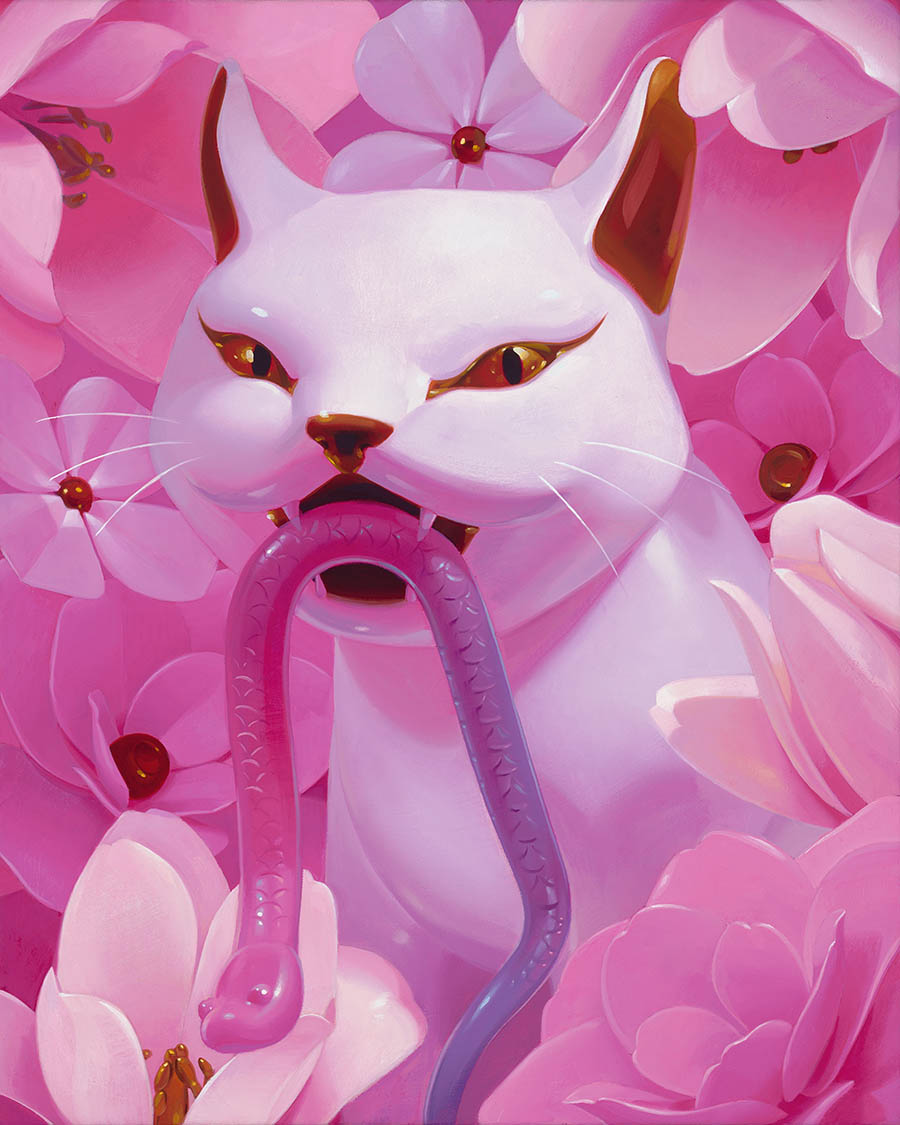
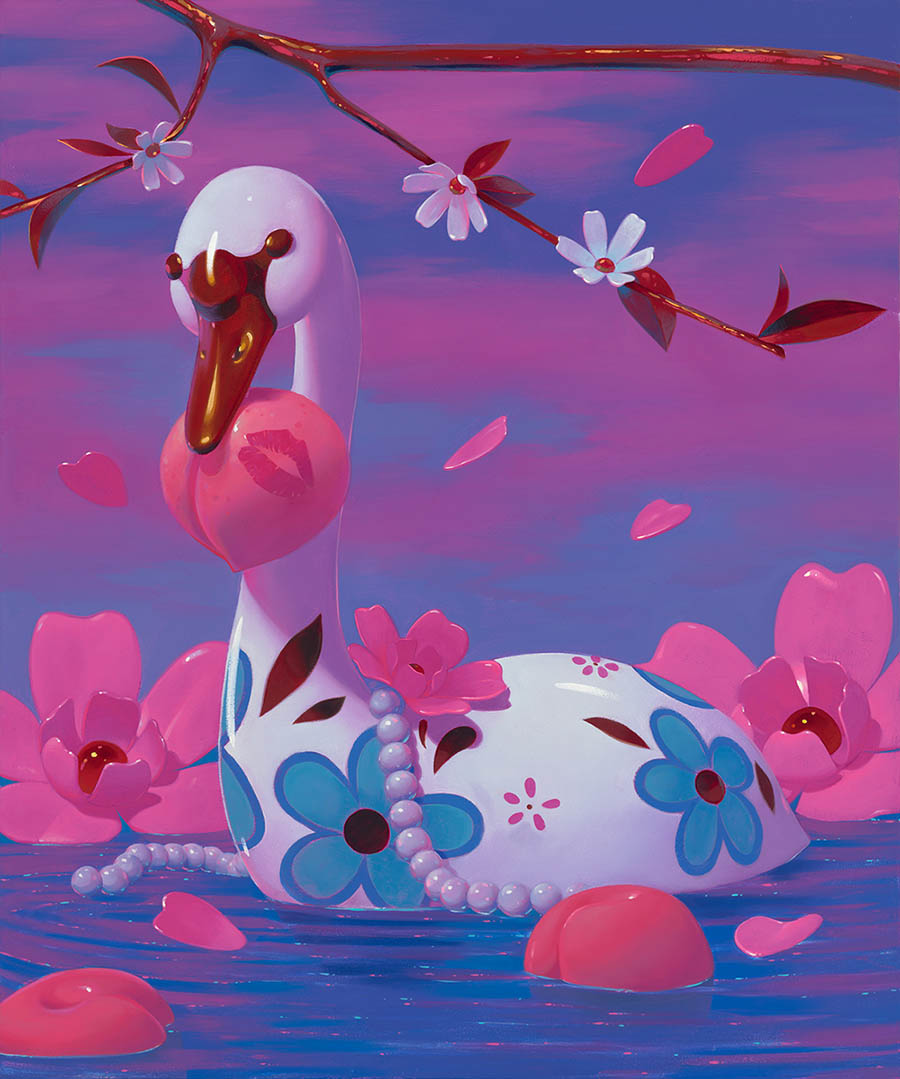
One thing I adore about your style is the shiny, plastic look of your subjects giving your work a Barbie’s Dreamhouse quality to it. How do you capture the texture/aesthetic using oils and can it be challenging to emulate traditionally?
Thank you! Capturing that glossy, synthetic texture is a mix of careful observation and technical skill. I’ve spent a lot of time studying how light interacts with different materials through observational painting, and I aim to capture the same interactions in my digital renderings, then translate that into oils through layering and blending techniques. There are a few different methods to creating gradients in paint – airbrushing is a pretty straightforward method but doesn’t allow for the same complexity of colours or depth of the medium I want in my work. I have a special method of layering rooted in classical painting that I use to create shiny, smooth, saturated surfaces without compromising the surface quality of the painting. The challenge lies in achieving a balance of making the surface look hyper-realistic but still maintaining the tactile quality of oil paint.
I read about your interest in Sianne Ngai’s essay on cuteness and how this aesthetic strips away any threatening qualities within a subject ultimately making them helpless in the eyes of this aesthetic. I’d love to hear more about your thoughts on this subject and how your perception of the cute aesthetic has evolved over the years.
My interest in kitsch, and its value as an aesthetic, led me to that essay, which in turn sparked my exploration of cuteness as its own aesthetic with inherent contradictions. Cuteness isn’t just about softness or innocence – it’s also about control. In its intended form, cuteness diminishes subjects by making them small, helpless, or non-threatening, which Ngai’s essay charts as the commodification of beauty. The fact that cuteness is femme-coded kind of says it all, and as I mentioned earlier, I really felt that control pushed on me from a very young age. Over the years, my perception has deepened, especially as I’ve worked to complicate this narrative. The cute subject appears easily manipulated, and yet, cuteness itself can be a form of manipulation. That’s where things get a bit more interesting, and that’s where my work has settled for the moment.

Can you further expand on the idea of cuteness itself being a form of manipulation and how you are further delving into that territory?
Cuteness is not just about evoking care or affection but also about asserting control from both sides. While on one hand, objectifying something as cute can be an act of asserting dominance and control, cuteness can also be wielded as a form of manipulation towards the objectifier. One great example is how domestic cats have evolved to meow at humans in a way that mimics the cries of an infant. It’s an adaptation that triggers our instinct to nurture, effectively making us more attentive to their needs. It’s a subtle, almost subconscious manipulation that serves the cat’s interests. By pairing traditionally “cute” imagery with elements that unsettle or disrupt, I want to draw attention to the deeper ways cuteness can charm and control. This duality allows viewers to reflect on their own emotional responses and the ways they subconsciously assign value or power based on aesthetic cues.
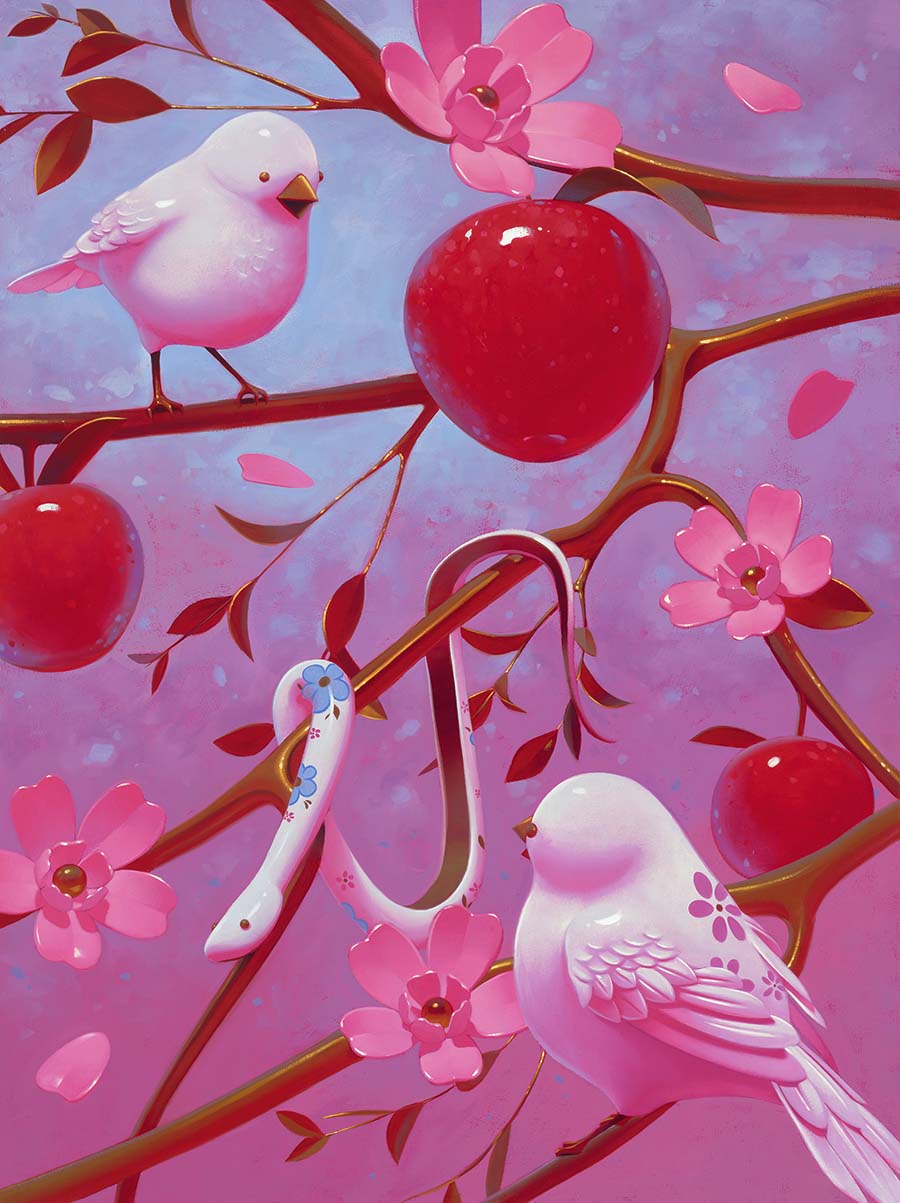
The cute aesthetic of your work is juxtaposed with darker imagery including skull motifs and animals that many people have phobias of such as spiders and snakes. This juxtaposition feels almost like an allegory for girlhood and the horrors that lie behind the curtain of being a woman. What do you make of this interpretation?
I think that interpretation resonates strongly with my intent. The juxtaposition of cute and dark elements mirrors the complexities of the femme experience, where there is constant interplay between the gritty reality, and the sparkly, hyper-commodified identity we’re told to inhabit. There’s a societal expectation for women to embody softness and non-threatening qualities, but there’s also an undercurrent of control, fear, vulnerability, and danger. My most recent work is definitely an exploration of these tensions and contradictions.
“There’s a societal expectation for women to embody softness and non-threatening qualities, but there’s also an undercurrent of control, fear, vulnerability, and danger. My most recent work is definitely an exploration of these tensions and contradictions.”
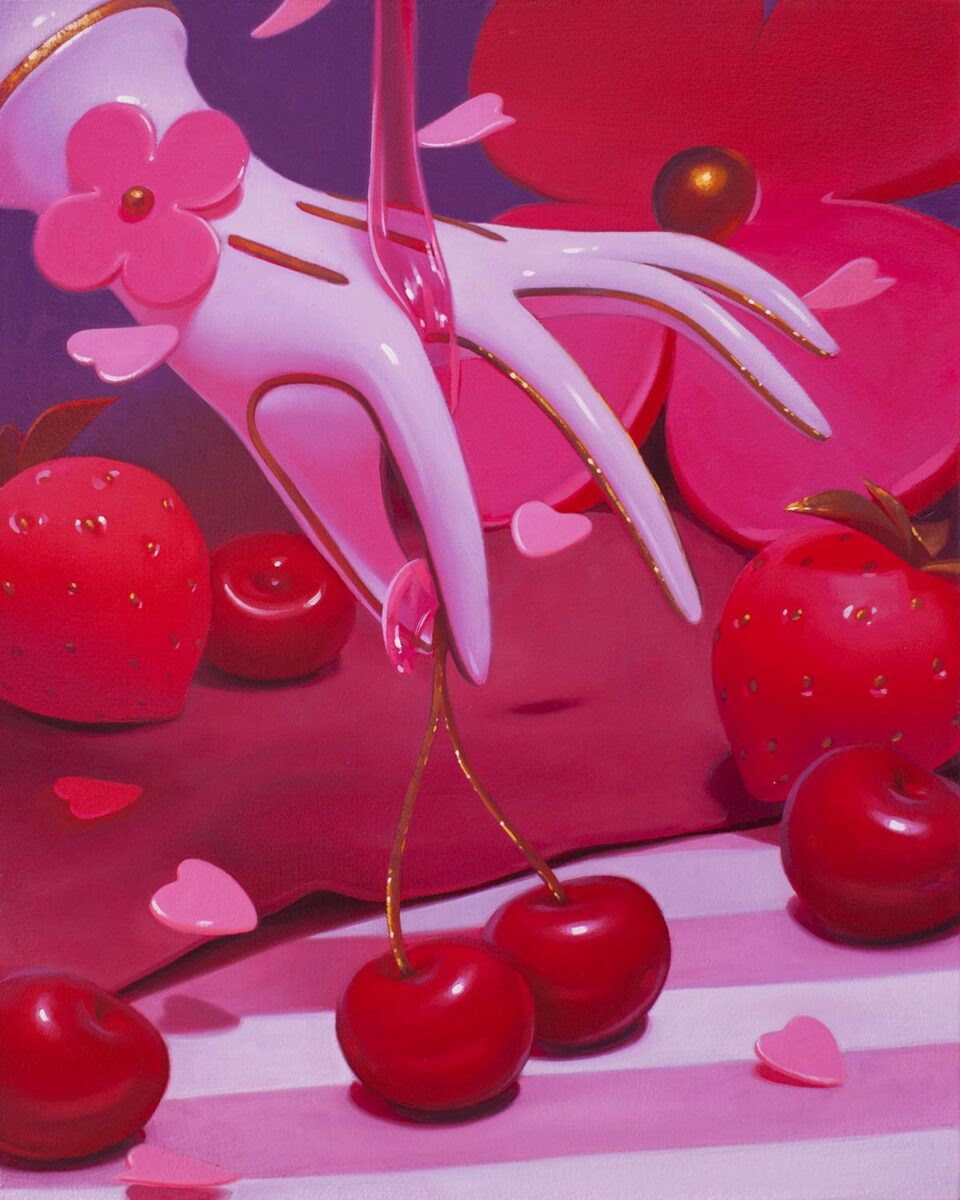
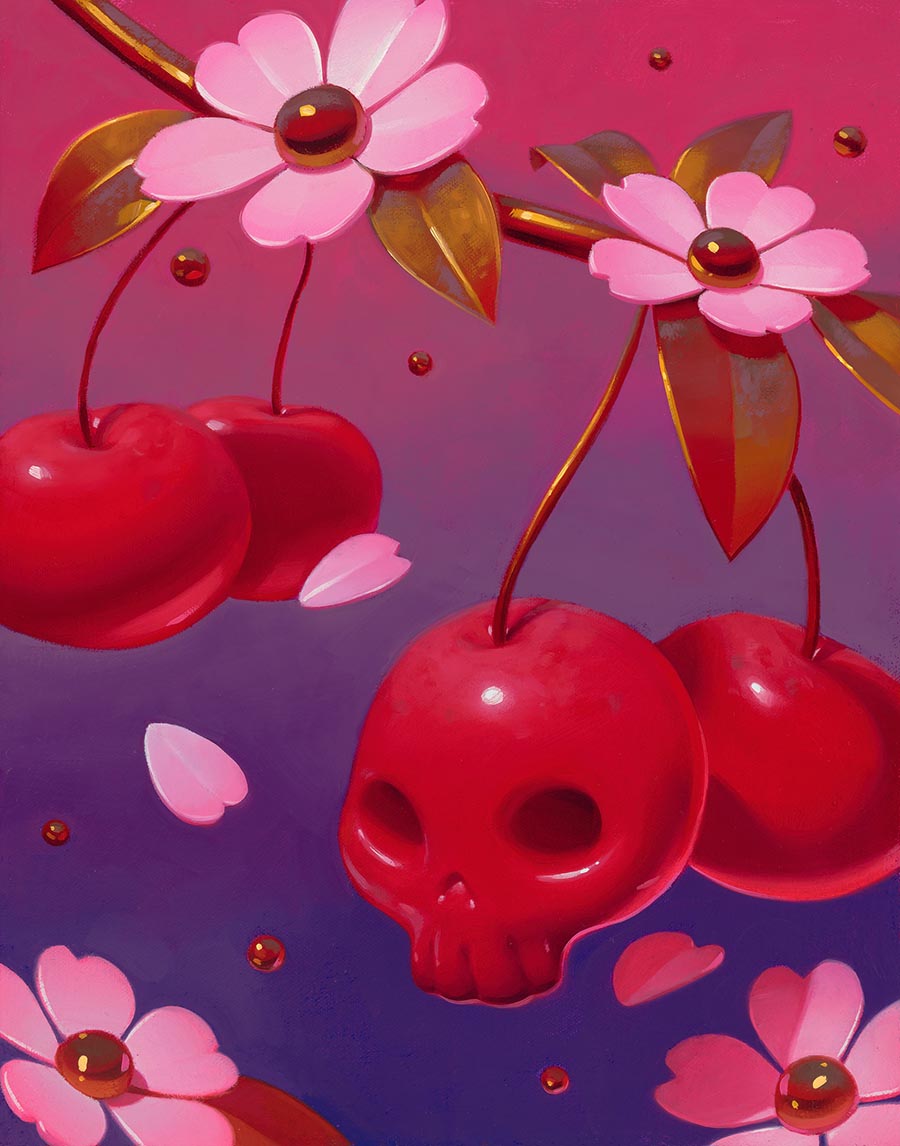
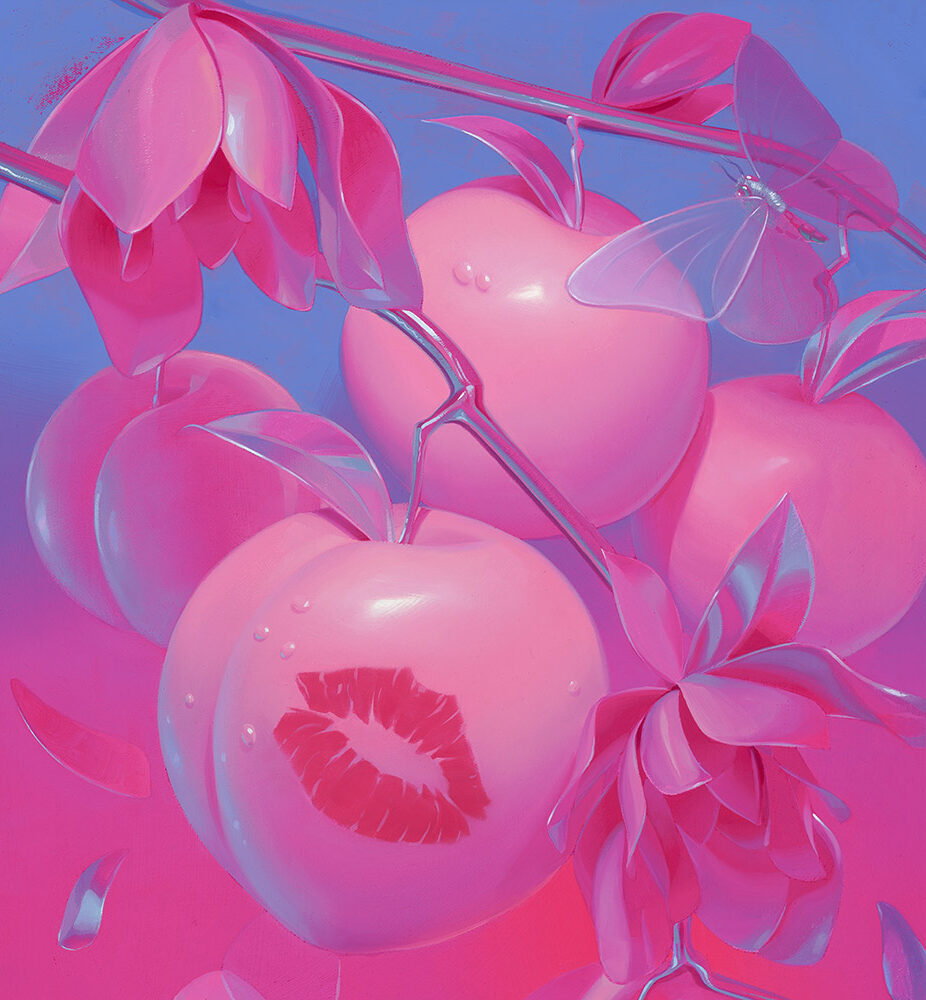
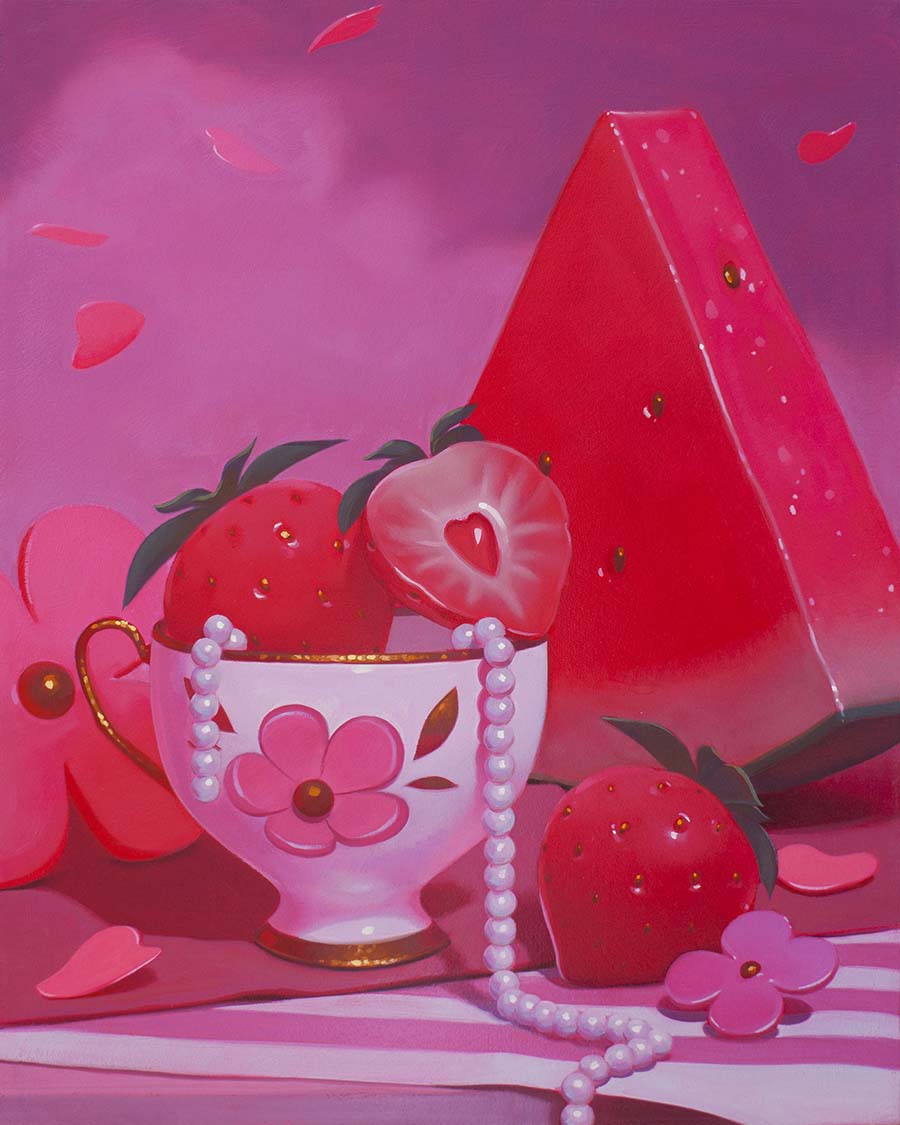
Many of your paintings feature fruit motifs including apples, peaches, strawberries, and pomegranates often paired with delicate feminine hands, are there sexual undertones to these fruits?
Absolutely. Fruits have long been symbols of sensuality, desire, and vice in traditional still-life motifs, and I lean into that history in my work. The tactile, fleshy
qualities of fruits, combined with their vibrant colours and juiciness, evoke pleasure, excess, and temptation. Where they would have contributed to an allegory in a traditionally religious still-life motif, I utilise them as direct stand-ins for the body. Paired with feminine hands, these motifs suggest intimate, sometimes playful interactions, celebrating or elevating the feminine subject.
What is the one thing you hope people can take away with them after viewing your artwork?
I hope my work inspires people to rethink where and why they assign value, particularly in relation to aesthetics. I want viewers to question the assumptions they hold about femininity and cuteness – what is considered high versus low, threatening versus safe, authentic versus artificial. We often don’t recognise that we carry these invisible burdens of assumption that are deeply rooted in power dynamics and control. Ultimately, I want my paintings to evoke a sense of curiosity and discomfort, but also inspire a little rebellion.
What has been inspiring you lately?
Since completing the work for my most recent exhibition at Hashimoto Contemporary, I am doing a little reset. I find it very important to step back from producing work, to ensure all of my ideas stay relevant and are coming from an authentic place. Right now, that looks like catching up with the people in my life, making time for things like reading and brainstorming, and taking classes to make sure I am always growing as both an artist and a person. I’m currently taking a few classes to brush up on my 3D and animation skills and am learning how to sew. I can’t say how these things will impact my work, but I always find the big shifts in my practice happen after these breaks, and I’m excited to see where this one takes me.