A personal journey through grief, the ghosts of the Dutch Golden Age, and the surreal magic of discovering a long-lost masterpiece. Article written by Iva Troj, PhD
When the Maashorst scandal hit the news, the small artist/historian collective I had been a proud member of throughout 2024 and 2025 caught fire—quite literally—as one of our Italian colleagues started waving in shock and accidentally spilled varnish on a server. Over 46 artworks, including an original €150 million Warhol, disappeared during a renovation. ‘It’s most likely that the artworks were accidentally taken away with the trash,’ the Maashorst municipality said in a statement. Everyone apart from the one Dutch person was shocked. ‘Yeah, this happens here from time to time,’ she said.
As a practicing professional artist, I see an art market deeply fractured between institutional gatekeepers and mass-production commercial galleries. It forces creators to constantly navigate an industry notoriously addicted to either exploiting or failing to pay its people. Frankly, not much has changed since the time of Leonardo and Caravaggio—well, apart from the fact that we are now facing unimaginably bloated AI companies burning millions of books and artworks to feed their chatbots. How does anyone deal with something like that? Being able to master that vulnerable yet fierce stance that gets me through the day is tough enough; now I have to face a digital Sack of Rome?
Three hundred and sixty-six years ago, in July of 1660, the preeminent landscape painter of Amsterdam, Jacob van Ruisdael, stood before a notary to formally testify that his young apprentice, Meindert Hobbema, had ‘served and learned with him for some years.’ Yet, what the legal document framed as a routine conclusion of service was, in reality, the beginning of a quiet rebellion.
For a brief window between 1660 and 1663, Hobbema found himself in a dangerous artistic purgatory—striving to emancipate his style from the overshadowing genius of his master while desperately securing the patronage necessary to survive as an independent master. There they stood, two men in wide-brimmed hats—a 17th-century prominent symbol of status, practicality, and identity—one already an undeniable master and one embarking on his own path, yet to become the indisputable master of Golden Age landscape art.
Who would have thought that now, over three-and-a-half centuries later, my life would cross paths with theirs—the two foreign men in wide-brimmed hats, the student and his teacher—two sleeping giants whose densely layered brushwork feels completely new despite centuries-old dust, well-meaning Victorian restorers with hot irons and unintentionally menacing aesthetic ideas, and thousands of historians working hard to decipher hidden meanings and intentions.
As a painter, one’s capacity for handling the realities of the art world is an often unwelcome, decisive factor in how one’s career is influenced by others. The industry doesn’t usually welcome creators who break easily under pressure and don’t show up consistently. I was born into a family that has endured so much turmoil and tragedy that trauma has lost its power over them, so I show up, even if it feels unbearable sometimes.
Almost every creative mind living rent-free in my head is exactly like I am—imposter syndrome meddling in what seemed sacred just minutes ago; the FOMO forced on one by outside forces; the constant questioning of one’s taste, intentions, and creative judgment, not because there is a reason for it, but simply because metacognition is often like performing surgery on oneself. So, naturally, I sometimes wonder if it is pure-hearted passion or mere stupidity that keeps me working. Or something much deeper.
The thing is, most of the work has very little to do with the physical handling of brushes and a whole lot to do with looking and seeing. When a true painter looks at works of art, they see them with their fingers. The thought is very similar to a memory of creating one’s own work. It is how my life crashed right into the reality of those two foreign men in wide-brimmed hats.
It all started with grief and shedding that last layer of giving a rat’s behind about the contemporary art world and its conduct. My father’s passing was a complete shock to the system. I had spent most of my life knowing that at least 80% of my creative wiring—from pattern recognition and fine motor skills to my ability to fail, dust myself off, and fail again until the work makes sense—is pure, unadulterated Dad. I didn’t know how to miss a human like that, so I packed my bags and took the train to Amsterdam, where another, smaller train took me to my childhood friend—painter and art historian—Rumi.
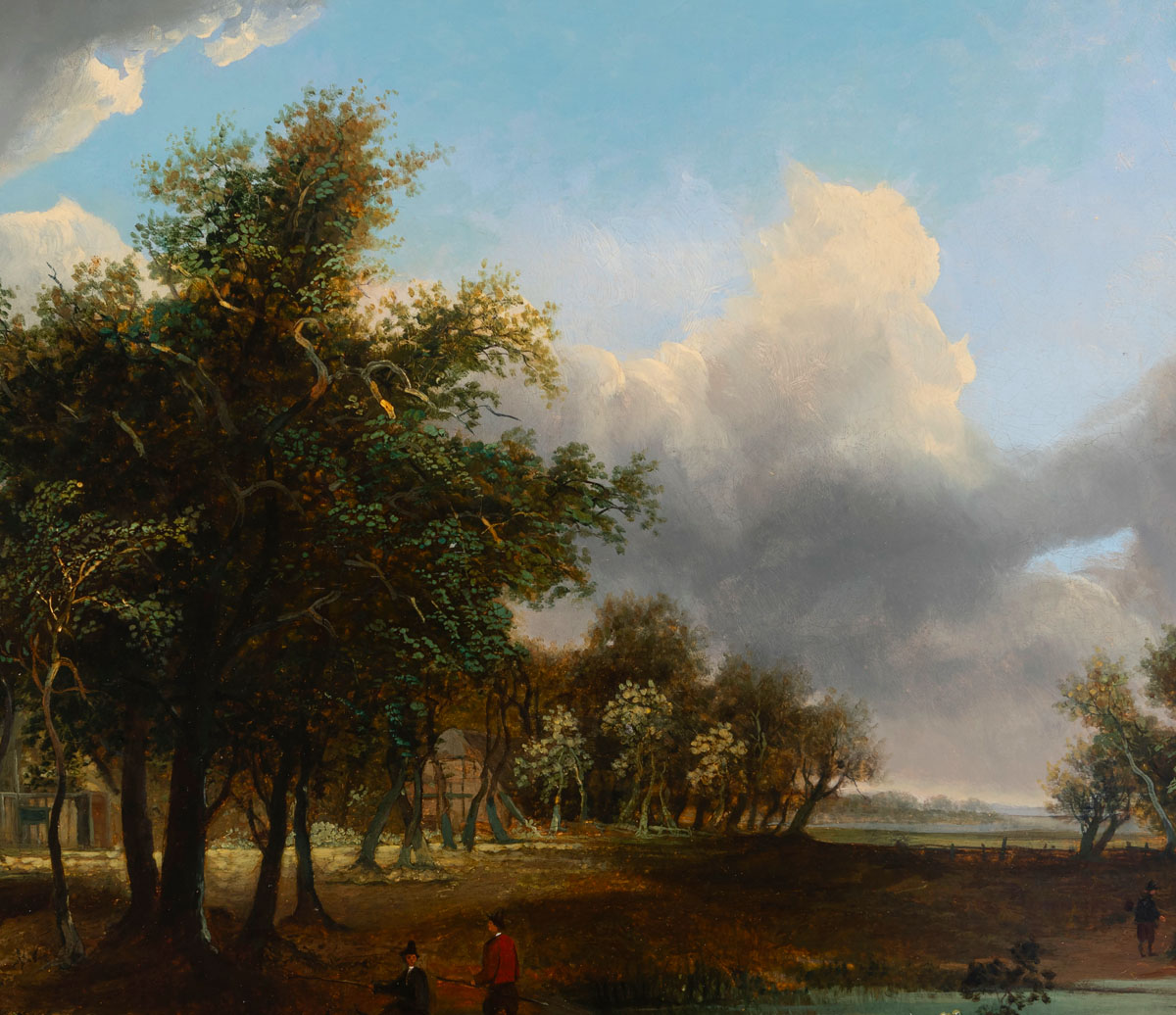
A couple of days later, on my birthday, Rumi offered to take me to an estate liquidation sale in a nearby town. It was there, staring at a canvas hanging above a tall, heavy cabinet, that I had an intense ‘seeing with my fingers’ experience. And it was very confusing because I fell head over heels but couldn’t make sense of it at all. It was just so damn shiny. How could something so old and so meticulously layered by what looked like the hand of a master be so flat and glossy?
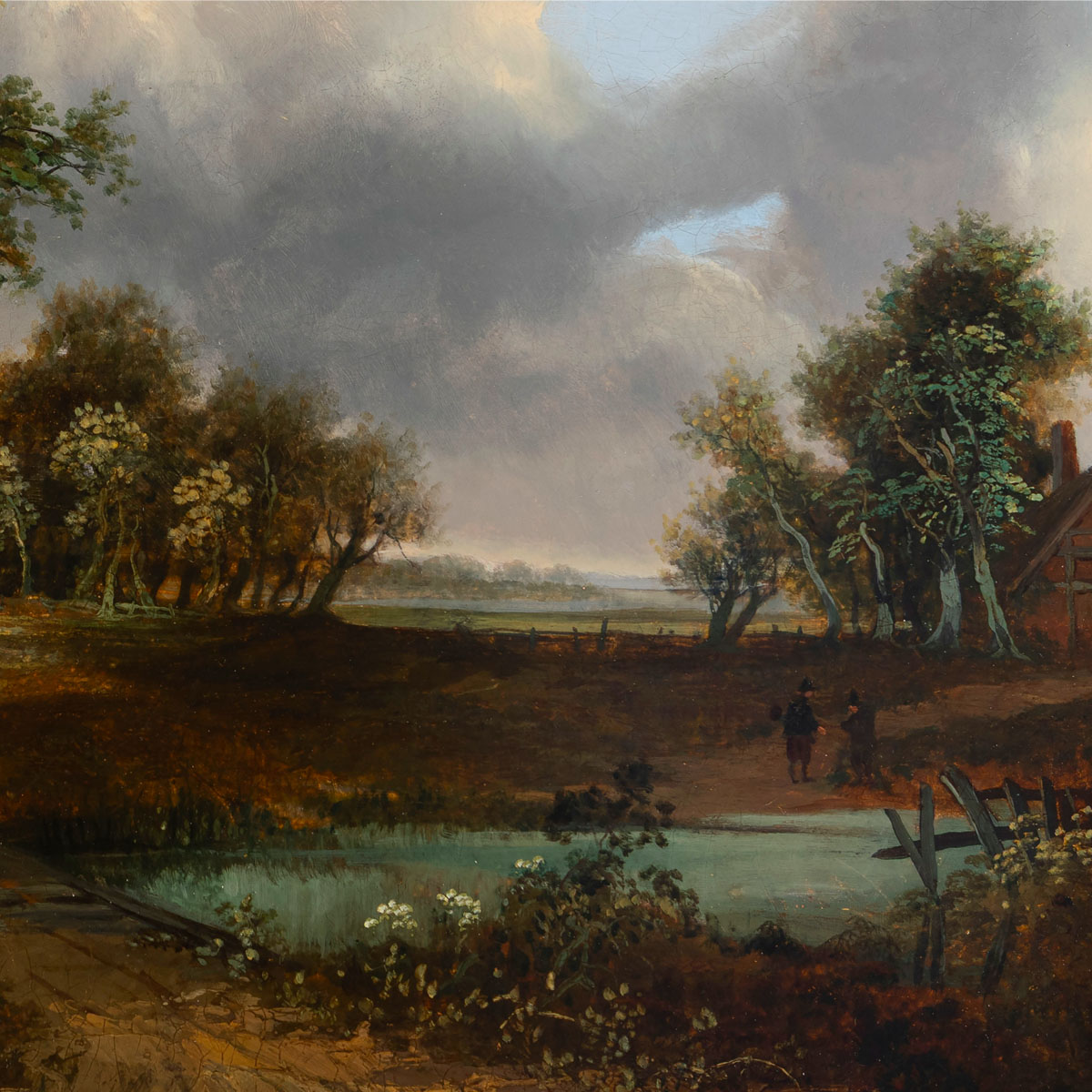
Growing up in Eastern Europe during turbulent times had taught me to always carry what my family sometimes refers to as ‘war cash.’ I never thought that I would use it to buy a strange canvas, marked ‘Anonymous,’ without any guarantees whatsoever that it was worth more than the sum of its wood and fabric.
I will never forget that moment of gut-wrenching silence when I received the painting almost a month later. It was placed between two sheets of cardboard, with nothing to protect it from the elements; five fresh, sweaty fingerprints marred the edge where someone who should’ve been wearing gloves had handled it carelessly, not knowing what was in front of them.
In that long moment, I was looking at the most beautiful thing ever created—that line where trees and sky met, carried by heavy clouds full of rain—brushstrokes that, to me, were unmistakably Hobbema’s. And yet, there was that glossy, whitish shine and the heavy-handed overpainting of two fishermen figures that made my eyes tear up. I grabbed onto it and carried it away, mumbling, ‘What the hell did they do to you?’
Later, in the safety of Rumi’s home, we looked at it with our phones and UV lights, hoping for at least a partial signature, or a small stamp on the verso, or just something indicating its presence in a 17th-century atelier. And it had absolutely EVERYTHING!
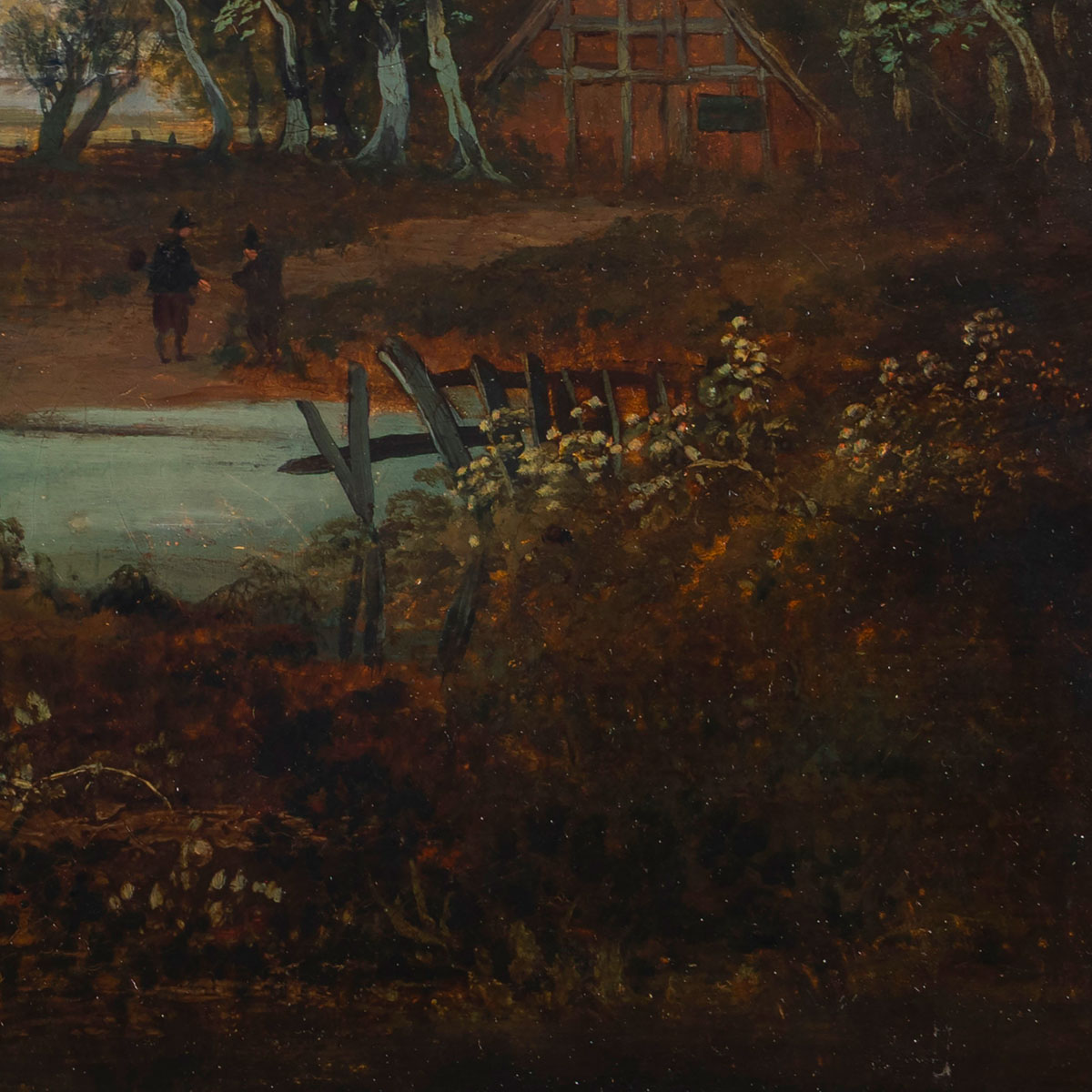
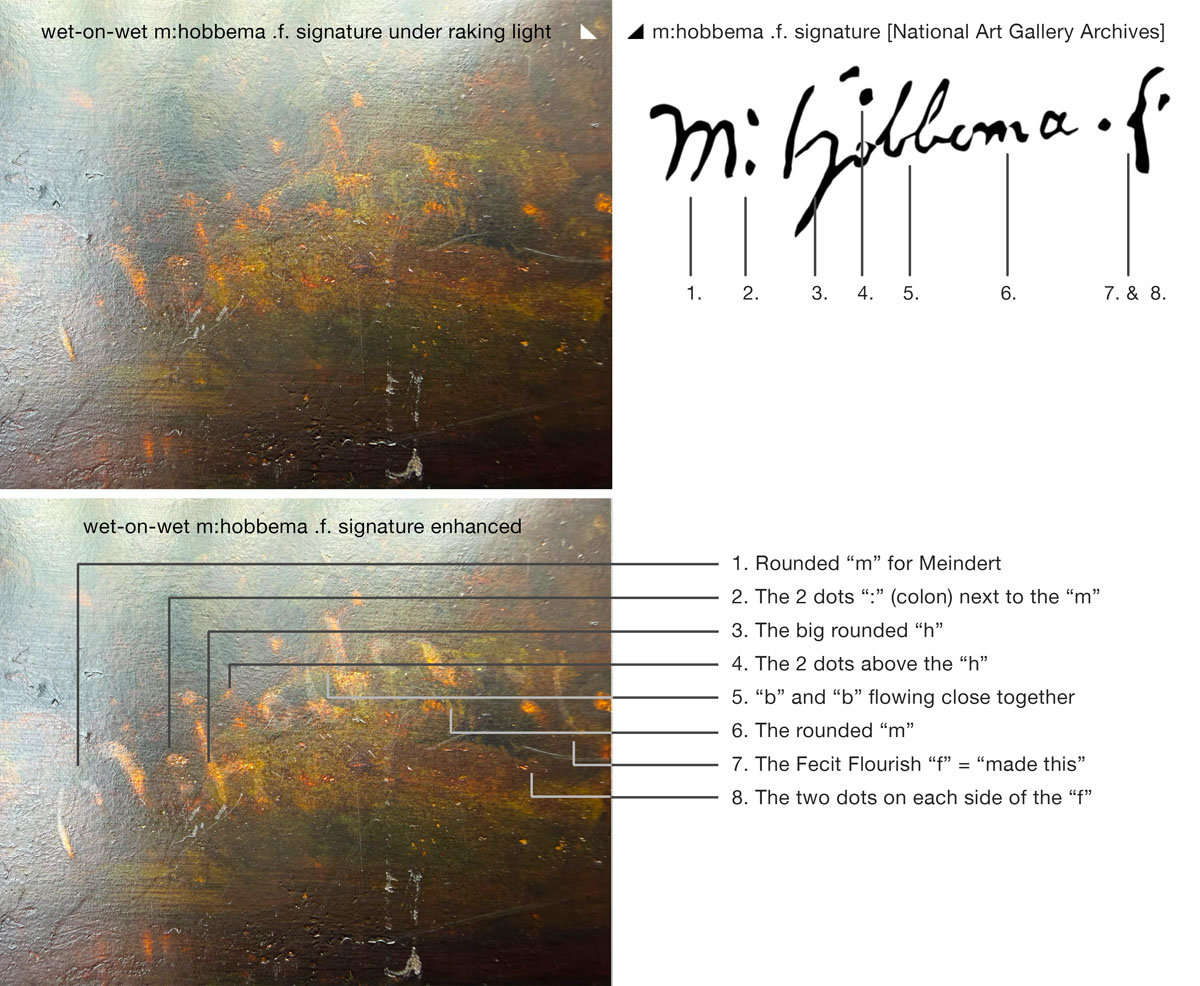
What followed was life-changing, nightmarish, and utterly mind-boggling: sleepless nights combing through hundreds of documents and archival newspaper pages, and sending endless letters to ducal estates in a futile attempt to get them to acknowledge their own ledger notations—only to be met with silence or brick walls. After all, few care to be reminded of the devastating 80% inheritance taxes that forced their estates to surrender priceless treasures to brokers.
Then there was that expert who very kindly offered his time and assessment without asking for anything in return, but couldn’t be convinced this canvas was anything but a 19th-century pastiche. The very present glossy pale film over the 360-year-old brushstrokes was messing everything up. Little did I know that this beautifully bizarre and increasingly frustrating layer was holding the key to the unique and fascinating history of this remarkable masterpiece.
While I was doing all this art-historical research, I learned so much about the master creator of this piece that I sometimes forgot about the centuries separating us. To me, he was a contemporary—not just because I was getting to know him and understood his ‘identity struggles’ to be a little more than a blip in the history of his labor of becoming, but because I was ‘seeing with my fingers’ all the time, even in my sleep. Because I did not know how much I needed this, how much I needed him.
For the past two years, my self-described ‘day job’ had been undeniably surreal. Fresh off major milestones—most notably the Halo Infinite Masterpiece painting and an exhibition at the Louvre Museum 2021 & 2022—I felt ready to break into the highest echelons of the secondary market. And when the opportunity presented itself, I did exactly that. Or so I thought. Signing with a private auction network to run exclusive events for their ‘high-tier collectors’ seemed like a brilliant move at the time. I should have done my usual deep-dive research, but instead, I jumped in feet first.
The first few auction events were great, if exhausting for an introvert in disguise. Before long, however, my delusions began to burst. I had been utterly convinced that authenticity was everyone’s goal—that by remaining true to myself, my process, and the quality of the work, we would all end up happy and rich. After all, in a world full of fakes, isn’t that where true value and exclusivity lie? So, I put on a suit, shared my life story, and sang the praises of representatives and ‘collaborators.’
After a year or so, I found myself desperately searching for that rare experience of ‘seeing with my fingers,’ but it was nowhere to be found. Instead, I began questioning everything: the quality of the materials, the provenance written on the backs of canvases, and the sheer ignorance born of the arrogance wrapped up in ‘exclusivity.’ I would stand beneath ‘Old Master’ labels, muttering under my breath, ‘Old, my patootie.’
Eventually, the contract dissolved for a reason almost too simple to grasp: when you are one of the very, very few ‘keeping it real,’ everyone else who is not will look bleak in comparison. And when collectors start demanding only ‘real’ art, a very big chunk of the business becomes unreliable. So, there you go. A near million-dollar auction-house profit later, the experiment was over and the contract was no more.
All of this happened at the same time as I was getting to know Mr. Meindert Hobbema.
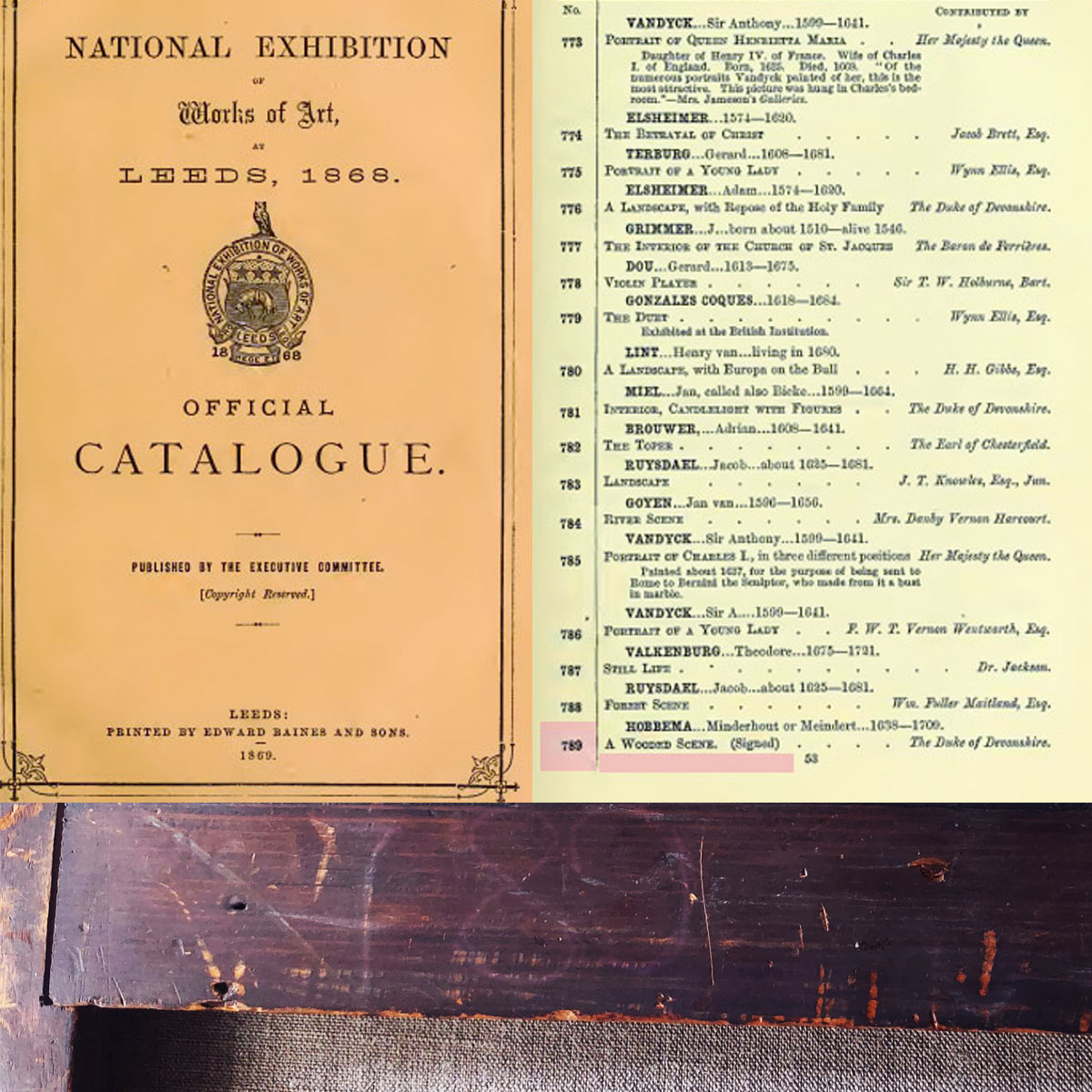
Below: Macro detail of the upper stretcher bar reverse, showing the historic handwritten entry number “789” in white chalk.
It must have been obvious to the small group of auctioneers running these private auctions that my attention was shifting, but I pride myself on being a pro, so I did my job. But the second I left the stage, I went right into the 17th-century rabbit hole. And, believe me, it is like a fairytale: deep and full of characters—princes, dukes, passionate historians, thieves, gatekeepers, bureaucrats, and sensitive souls trying to make a true effort, only to be crushed by a mountain of responsibility.
What recent developments in forensics have done for the whole authentication business is truly remarkable. According to leading art-world experts, it is most likely that at least 30% of the art in museums and private collections is mislabeled, with faulty provenance attached.
Doing the kind of research I had to do is riddled with danger, but all for a good reason—the burden of proof lies with me. So, by the time I had replenished part of the ‘war cash’ in my possession, I had to spend it again, this time on forensics.
Time and time again, I was confronted with numerous experts scratching their heads over that glossy film that had already caused so much trouble. I had already gone over the two-and-a-half-page-long provenance dossier several times, removing everything, however logical, that couldn’t be backed by ironclad physical evidence. But it was not enough, so I contacted the highly reputable Tager Stonor Richardson team to do an infrared reflectography examination of the canvas.
What their report revealed a month later made me immediately pack the piece away in a large metal box and drive it to a secure, climate-controlled art storage facility almost a hundred miles away. Good thing I had photographed every millimeter of the front and the back, because those photographs became the basis for unlocking this masterpiece’s biggest secret.
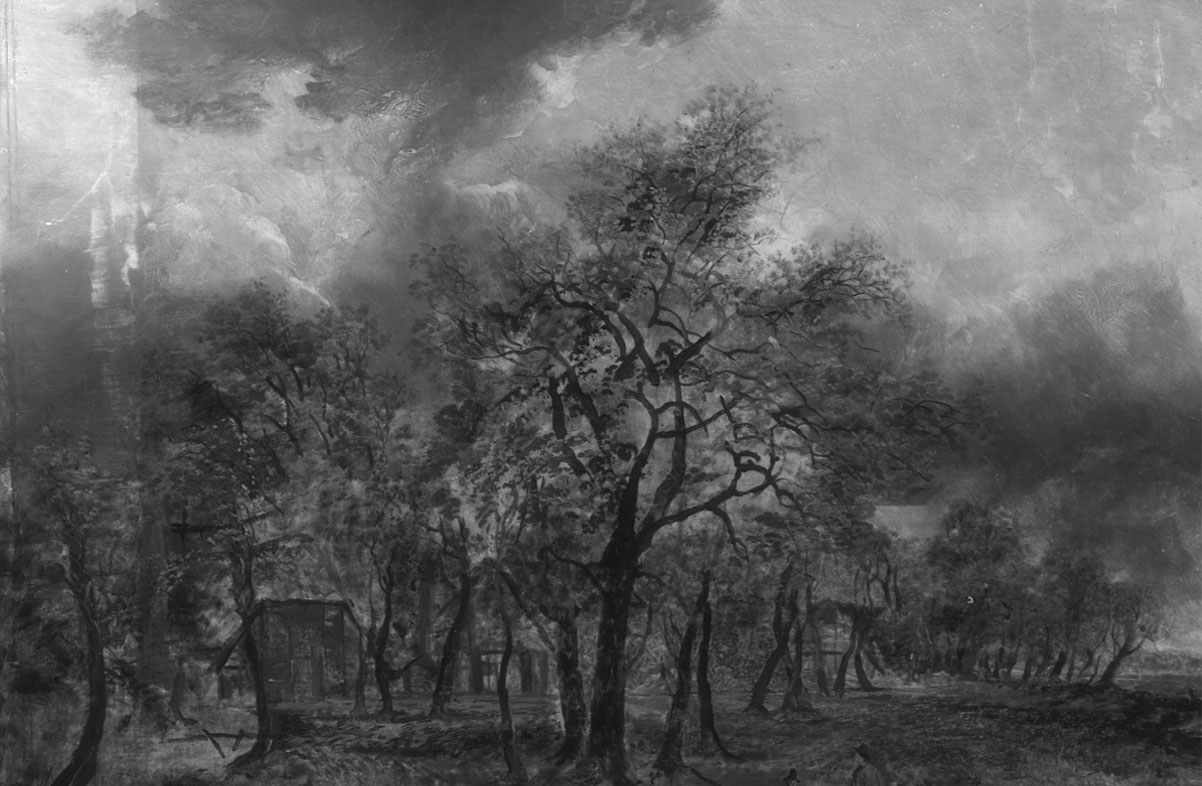
The thing was, while the TSR team was analyzing the infrared reflectographs, I was looking at photos taken with an old smartphone. The software in those phones handles insufficient data in remarkable ways; it is sometimes much easier to find things written with long-faded ink or stamped into wood with tiny 11-mm stamps. One day, looking at these photos with aching eyes and not being able to sleep, I saw something: three capital letters perfectly shaped and visibly stamped on the stretcher—the letters F.H.L. I immediately looked it up and voilà: prominent Victorian-era restorer Francis Henry Leedham. Where had I heard this name?
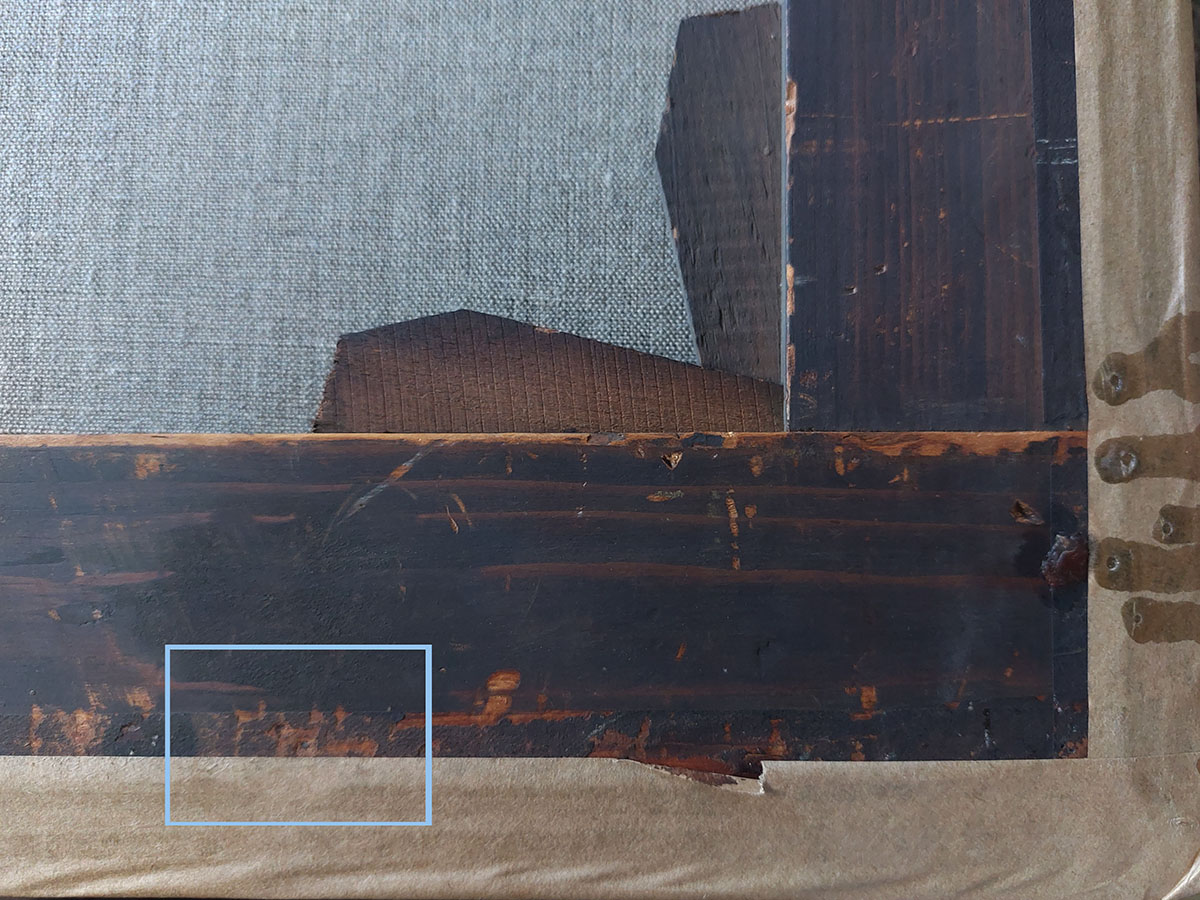
I emailed TSR the next day and put everything away. My thoughts were racing, but I couldn’t remember where I had heard the name. The fact that this beautiful masterpiece was restored more than once was already well-documented from the macro photos and the UV examinations Rumi helped me with. An art historian with over two decades more experience, she knew how to read aging materials. But we weren’t sure of the specifics. Until F.H.L. entered the dossier. What I could not remember gave me insomnia, but TSR’s report was well worth the wait.

Francis Leedham was a bit of a legend, you see. He had a restoration technique that even today sounds revolutionary. When a very old painting on wood was in decay and/or suffering from a woodworm infestation, he would save it by transferring it to canvas. I remember hearing about this in a lecture when I was doing my art history PhD, and I remember having an argument with the professor, claiming it couldn’t be. Like… how?
The process is as terrifying as it is brilliant. First, you face a crumbling, insect-eaten 17th-century oak panel, its painted surface slowly flaking into oblivion. To save it, you don’t fix the wood—you destroy it. You paste layers of protective paper and fabric directly over the face of the painting to lock the loose flakes in place. Then, turning the panel over, you painstakingly shave, plane, and scrape away the centuries-old wood from the back until absolutely nothing remains but a micro-thin skin of original paint and primer.
Finally, using a specialized adhesive, you fuse this floating film of color onto a brand-new, flexible canvas before gently dissolving the protective face-coverings. It is the ultimate illusion: a painting that looks entirely intact, yet the physical ground it was born on has vanished into sawdust, replaced by fabric that was never supposed to be there.
Archival records confirm that Leedham performed multiple panel-to-canvas transfers for Lord Northwick during the 1840s to prepare the peer’s vast collection at Thirlestaine House for public display. Lord Northwick was already a prominent presence in the painting’s dossier. We only knew of three such panel-to-canvas transfers, and this masterpiece seemed to be one of them.
At that point, I was losing my mind, completely unprepared for something so life-changing. It was overwhelming, to say the least—especially because I had conducted the bulk of this research entirely on my own while quietly completing my art authenticator degree, relying on the discretion of only a few trusted friends and immediate family.
But the proverbial elephant had filled the room, and I couldn’t avoid it any longer. Yet, even as the small group who knew about the piece pressed me with the terrifying question—What are you going to do with it?—I realized I wasn’t actually alone. A wider collective of artists, historians, ‘sleeper hunters,’ rescuers, and cultural caretakers is quietly growing around me. We are feeling a massive, undeniable call to gather, protect our heritage, and act together. Just moments ago, we decided to call ourselves The Human Beat.
On a personal level, the honest answer is: I don’t know. Maybe I will write a book. Or perhaps I will dive deeper into a highly plausible hypothesis—that this painting was originally part of a pendant pair. Numerous infinity markings on the verso point directly to this conclusion. Now that we know it was once a panel, The Watermills at Singraven near Denekamp seems to be its only perfect match and mirror image. It features multiple details with striking similarities, from the composition and palette down to identical figures and clothing.
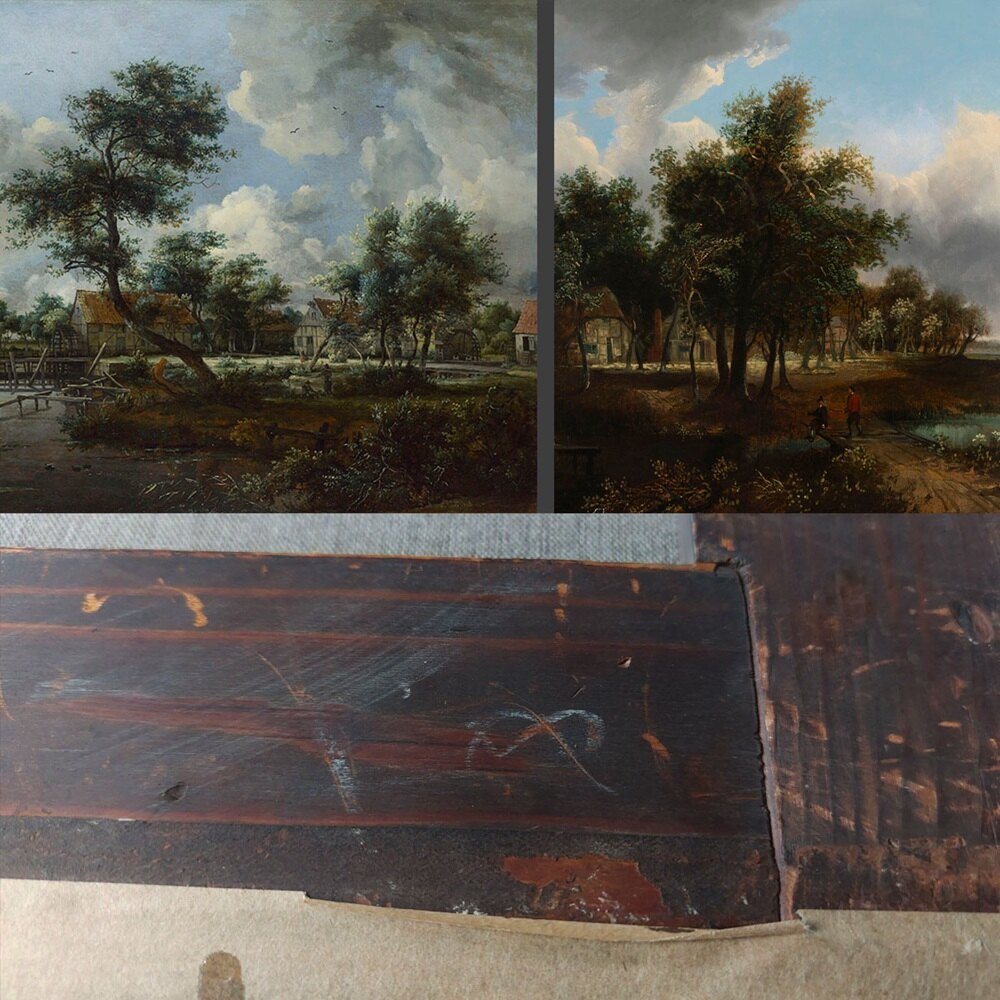
Yet, I feel no pressure to make a decision—and not because, as one friend suggested, “it’s a great thing to own.” It was never about ownership. From the very moment I laid eyes on it, I felt that it wasn’t my karma that placed this three-hundred-and-sixty-years-old masterpiece on my path, but its own. It chose me as its caretaker, and for that, I will be grateful until my dying breath.
Either way, the choice will be easier now that there are two of them. By the end of summer, I was back at the exact same estate liquidation for round two—staring straight at a masterpiece by Hobbema’s teacher.
Seven decades ago, another caretaker packed these masterpieces away to protect them—just as I did. What happened to her or him may forever remain a mystery.
As for my ‘day job’—I am going to head back into the studio, put on Catching Flies and Tryphn and paint. Then one day, when the first signs of spring make me smile, I will sit down and write a letter to the Getty, asking for permission to examine a panel by Hobbema that bears an uncanny resemblance to the masterpiece I am now caring for.