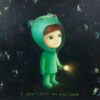
Felicia Feldman is a Beautiful Bizarre Artist Directory member provides some fascinating insights into her practice and experiences as she responds to the questions below:
- What piece of advice do you have to unlearn to get the next step in your art career?
- If the child version of you could see you now, what do you think they would say/think?
- How do you approach the challenge of staying motivated and inspired in your art practice?
- How do you differentiate yourself and your work from other artists in your field?
What piece of advice do you have to unlearn to get the next step in your art career?
I had to unlearn the impulse to follow trends and instead create work that felt authentic to me and my own vision. Early in my career, I would research galleries I aspired to be represented by and study the styles that seemed most popular, often trying to emulate what I saw. Ultimately, that approach didn’t work for me; I found myself bored, uninspired, and disconnected from the work I was making.
I eventually shifted the trajectory of my career and focused primarily on teaching. As an instructor, I constantly encouraged my students to trust their instincts and stay true to their individual visions. Over time, I realized I needed to take my own advice. Once I began making art rooted in my own life, interests, and aesthetic, something changed. I became genuinely engaged in the process again, and each painting began to feel distinctly my own.
While I’ve loved creating art in many different forms for as long as I can remember, I think the child version of me would be surprised by where I ended up. As a little girl, I always imagined I would become a musician. In high school, I was heavily involved in Youth Symphony, attended summer music camps across the country, and practiced the violin every day. I loved visual art as well, but at the time, it was more of a hobby.
Eventually, I realized that I loved painting more than I loved playing the violin, and I made a fairly sudden change in direction. In college, I envisioned becoming a gallery artist—exhibiting my work and supporting myself through painting. The reality, however, was much different. I needed to earn enough to live independently, and after years of working jobs outside of the arts, I became too burnt out to create. For nearly a decade, painting largely disappeared from my life.
I eventually found my way back to art, although not quite in the way I had originally imagined. Today, I spend more of my time as an instructor than as a painter. While this somewhat wayward trajectory might sound discouraging, I’ve come to see its value. The experiences I’ve had, along with the risks I’ve taken and the changes in direction, have made me more resilient. They’ve also given me a much broader range of experiences to draw from—both in the way I teach my students and in the ideas and concepts I explore in my own work.


If the child version of you could see you now, what do you think they would say/think?
While I’ve loved creating art in many different forms for as long as I can remember, I think the child version of me would be surprised by where I ended up. As a little girl, I always imagined I would become a musician. In high school, I was heavily involved in Youth Symphony, attended summer music camps across the country, and practiced the violin every day. I loved visual art as well, but at the time, it was more of a hobby.
Eventually, I realized that I loved painting more than I loved playing the violin, and I made a fairly sudden change in direction. In college, I envisioned becoming a gallery artist—exhibiting my work and supporting myself through painting. The reality, however, was much different. I needed to earn enough to live independently, and after years of working jobs outside of the arts, I became too burnt out to create. For nearly a decade, painting largely disappeared from my life.
I eventually found my way back to art, although not quite in the way I had originally imagined. Today, I spend more of my time as an instructor than as a painter. While this somewhat wayward trajectory might sound discouraging, I’ve come to see its value. The experiences I’ve had, along with the risks I’ve taken and the changes in direction, have made me more resilient. They’ve also given me a much broader range of experiences to draw from—both in the way I teach my students and in the ideas and concepts I explore in my own work.


How do you approach the challenge of staying motivated and inspired in your art practice?
I love learning—about art, of course, but also about nearly everything else. I find inspiration in places that may seem unrelated at first: my dreams, observing the ways people interact and imagining small narratives about their lives, or discovering an interesting fact about an animal, psychology, history, or the natural world. I am endlessly curious about why people behave the way they do, how we relate to one another, and the details of the world that are easy to overlook.
For me, this curiosity is an important part of being an artist. The more I learn and observe, the more material I have to draw from—not necessarily in a literal sense, but in the ideas, emotions, and questions that eventually find their way into my paintings. Paying attention keeps me connected to the world around me while also encouraging me to reflect on my own experiences and inner life. I never quite know what will spark an idea for a painting, which is part of what keeps the process of creating so engaging for me.


How do you differentiate yourself and your work from other artists in your field?
Personally, I don’t believe representational art can ever be entirely original. After all, as representational artists, we are inherently interpreting and imitating something we observe in life. For that reason, I find it difficult to define my work by what distinguishes it from that of other artists. Instead, I think its identity lies in the narratives I choose to tell.
My paintings often explore the varied and significant roles women occupy in our society. These narratives are coupled with elements of magical realism and, at times, an undercurrent of emotional darkness. Visually, my work draws upon the aesthetics and traditions of art history, while the subjects and stories remain distinctly contemporary.

Join cutting-edge artists from around the world
The Beautiful Bizarre Artist Directory is a powerful tool for artists looking to grow their visibility, and connect with fellow artists, curators and collectors. To join the Beautiful Bizarre Artist Directory click here for more information.